Share the page

Agustine
Project
Published on
-
Project start date
-
Status
Ongoing
-
Project end date
-
-
Financing amount (Euro)
-
18.8m
-
Country and region
-
El Salvador, The Americas


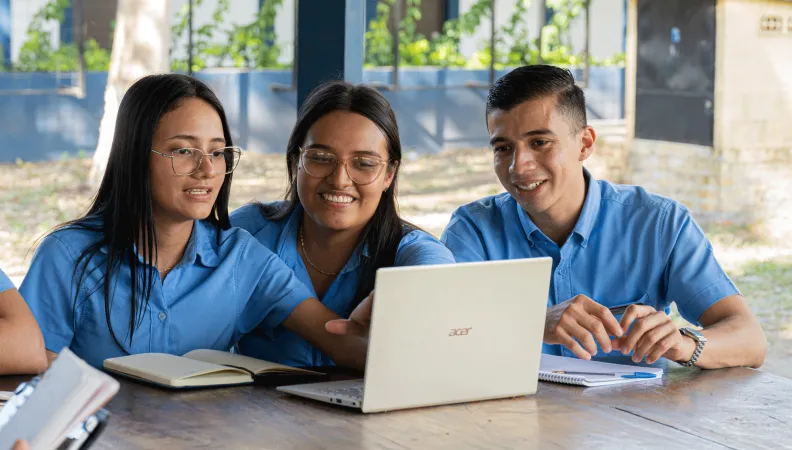
The Agustine project seeks to strengthen educational and inclusion opportunities for vulnerable adolescents and young people in El Salvador.
A European project carried out in close collaboration with Salvadoran partners
Agustine was created in November 2024 with the aim of expanding educational opportunities for vulnerable adolescents and young people, including those engaged in a process of social reintegration. The project falls within the framework of El Salvador’s national strategy for violence prevention. During its 48-month implementation period, Agustine is seeking to transform people’s lives and contribute to improving living conditions in the country, by reducing social vulnerability to violence and delinquency.
Agustine’s implementation is conducted in close coordination with the Ministry of Education, Science and Technology (MINEDUCYT) and the National Council for Children and Adolescents (CONAPINA). It is helping to guide the national efforts set forth in the 2025-2029 MINEDUCYT Institutional Strategic Plan, the Mi Nueva Escuela educational reform and the 2022-2030 Education Sector Plan, which are all geared toward ensuring inclusive, equitable, and protective education. Agustine is thus helping to strengthen the actions supported by the European Union in El Salvador in the area of violence prevention and social reintegration.
Agustine: improving living conditions in El Salvador through education
The main objective of the Agustine project is to improve living conditions in El Salvador, for a reduction in social vulnerability to violence and delinquency among children and adolescents. To carry out its goals, the project actions are based on (i) schools as places of socialisation and spaces of participation and discovery and (ii) educational communities as vectors of change. These actions involve preventing violence, building a culture of peace, enhancing student well-being, and developing social-emotional skills. In this way, young people at social risk are offered opportunities for inclusion, employability, and active citizenship.
More specifically, the project contributes to:
- improving psychosocial care services for the educational community, with activities that include family education and the taking into account and promotion of well-being and mental health at school and within the educational community;
- facilitating the insertion of young people and adolescents into the professional world: development of vocational orientation skills, raising young people’s awareness about the professional world and entrepreneurship, work on vocational school curricula;
- boosting participation by girls in school inclusion programmes: development, implementation, and monitoring of gender equity and equality action plans in schools.
Increasing access to education
The activities implemented as part of the project help boost access to education by taking into account psychological needs, emotional well-being, and equal opportunities issues:
- mainstreaming of emotional and family well-being strategies into institutional plans and school life;
- training of teachers and management teams in social-emotional learning, brain education, self-care, and school mediation;
- support for students in social-emotional learning;
- support for mothers, fathers, and families in order to bolster parenting skills.
Improving and diversifying the education system’s soft-skill development offer
The project is helping to enhance the educational offer relating to soft skills (life skills), the positive transformation of conflicts, and citizen participation:
- strengthening of governance systems within schools;
- development of curriculum-related socio-educational activities, involving members of the educational community, with the goal of promoting the development of civic skills;
- establishing organisations and processes that promote student leadership and participation.
Improving and diversifying the educational offer on productive skills
The project works on:
- enhancing vocational and professional diploma programmes linked to the MEGATEC programme;
- providing institutes with equipment;
- implementing a programme on career guidance and entrepreneurial culture;
- initial technical education;
- technical training and certifications.
Enhancing gender equality
Schools are implementing the Ministry of Education, Science and Technology’s Equity and Equality Policy, through equality and sexual violence-prevention plans. This includes the following actions:
- teacher training on equality and violence-prevention plans;
- support for schools for implementing equality and sexual violence-prevention plans;
- monitoring and evaluation actions;
- evaluation and updating of the Equity and Equality Policy.
Sustainable Development Goals
SDG4 - Quality education
Ensure inclusive and equitable quality education and promote lifelong learning opportunities for all
SDG5 - Gender equality
Achieve gender equality and empower all women and girls
SDG10 - Reduced inequalities
Reduce inequality within and among countries
SDG17 - Partnerships for the goals
Revitalize the global partnership for sustainable development
On the same topic
PAIRE - Institutional Support Project for Education Reform in Mauritania
Ongoing
2023 - 2026
Funders : European Union
Africa Connect Digital Campus
Ongoing
2025 - 2029
Funders : European Union, Ministry for Europe and Foreign Affairs of France
In the news
Back to school: for secondary education that takes into account everyone’s needs
Published on September 2, 2026