Share the page
Back to school: for secondary education that takes into account everyone’s needs
Published on
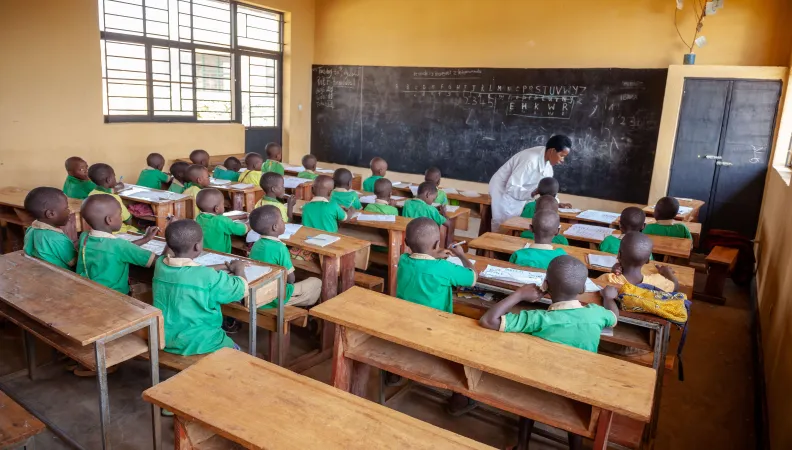
Educational reform must take into account the challenge of inclusion in secondary schools, as students need not only access, but also the chance to fit in and build their future there. That’s why Expertise France is helping to guide reforms in Cambodia, Djibouti, and The Gambia aimed at diversifying educational pathways, improving gender equality, and better meeting the needs of every student.
Education is an essential component of the Sustainable Development Goals, and by committing itself to SDG 4 the international community must ensure good-quality, inclusive, and equitable education for all. Access to schooling has improved in many parts of the world, but substantial inequalities remain, particularly in secondary education, where students’ chances to continue in school and succeed in life can still be determined by their social background, gender, or a disability. Besides access to school, additional challenges are to build education systems than can accommodate a wide diversity of students, prevent them from leaving school early, and offer pathways tailored to each individual’s aspirations and abilities.
Expertise France works on projects to support ministries of education in their reforms by drawing on French and European expertise and promoting peer-to-peer exchanges. In Cambodia, Djibouti, and The Gambia, three of our projects illustrate complementary approaches to making secondary education a more inclusive environment.
Cambodia: diversifying career paths to make sure everyone fits in
In Cambodia, technical education is a key pathway for preparing young people to enter the job market and for meeting the country’s need for qualified technicians in STEM (science, technology, engineering and mathematics) subjects. A twinning programme funded by the European Union (€2.5 million) is supporting Cambodia’s technical and vocational education reform at the upper secondary level.
France, Germany, and Finland are working in a consortium to implement this project, which provides support for (i) developing an apprentice-based learning system in close collaboration with businesses; (ii) improving curricula, teaching programmes and educational resources; and (iii) training teachers in the five key sectors of IT, electricity, electronics, food processing, and mechanics.
France, through Expertise France and France Éducation Internationale, is coordinating the component dedicated to initial and continuing training for teachers. International experts and teacher trainers are working together to develop and put into action the new training plan. Seven priority modules have been designed to meet the professional development needs of teachers in the technical sectors targeted by the project. Through a peer-to-peer approach, teacher trainers and Cambodian ministry officials are also taking part in exchange programmes in Europe to learn about other education systems, exchange views with their foreign colleagues, and then contribute to reforms in Cambodia.
The project puts a special focus on digital skills, low-carbon technologies, and getting girls to study STEM subjects.
The idea is to transform the image and role of technical education so that it offers a broader range of training pathways; promotes diverse, innovative, and practical skills; and enables each person to find a pathway that matches their aspirations.
Djibouti: promoting inclusion for each student’s pathway
In Djibouti, reform focusing on a comprehensive secondary school represents the start of a new phase for the education system. To support the Ministry of National Education and Vocational Training in this transformation, the “Polyval” Technical Assistance programme was launched in June 2026. It is funded by AFD (€1.65 million) and implemented by Expertise France in partnership with France Éducation Internationale.
This technical assistance is helping the ministry to design general and technological education reform, which will be showcased by the future comprehensive secondary school. The reform is based on the principle of inclusion from an overall perspective: it includes not only equality between girls and boys, but also social and geographical dimensions and the system’s capacity to offer personalised pathways tailored to each student’s aspirations and abilities.
The project is based on peer-to-peer cooperation: international experts are working in tandem with their Djiboutian counterparts to promote skills transfer and ownership of the reform. Polyval is currently helping to develop the Curriculum Framework, which is to be finalised by the end of 2026. The reform will then be rolled out gradually across the country, starting with Year 10 at the start of the 2027-2028 academic year.
The Regional Initiative for Teachers in Africa Facility is backing up this initiative by broadening its scope of action to include system-level structuring of the education system, particularly with regard to key themes such as continuing training for teachers, gender-sensitive management, and inclusive education.
The purpose is to make diversification of career paths a lever to help each young person find their own way.
The Gambia: removing barriers to success for girls and boys
In The Gambia, the “EU Support to Improve Secondary Education for Youth” (EU-ISEY) project, funded by the European Union, is working to remove the barriers that still limit access to and successful completion of upper secondary education. In 2023, the rate of completing high school stood at just 46.6 per cent nationally, with especially big challenges for girls and boys living in rural areas (completion rate of 11.2 per cent).
The many obstacles include economic difficulties, inadequate infrastructure, a lack of facilities suitable for students with disabilities, as well as early marriages, pregnancies, and family responsibilities.
The EU-ISEY project works toward better access to and retention rate for both girls and boys in upper secondary education that seeks to be inclusive, in particular by supporting vulnerable students, guiding transitions between educational stages, and engaging local communities.
It also seeks to improve the quality and gender sensitivity of education, particularly in STEM and digital technology subjects, via training for teachers and principals, more inclusive teaching practices, and the integration of skills needed for the green and digital transitions.
Finally, for there to be inclusion, the teaching personnel must include more women, who account for less than 20 per cent of upper secondary school teachers in rural areas. The project works to improve gender balance among teaching personnel and increase women’s access to the profession, in particular through scholarships, training, mentoring, and leadership programmes.
Expertise France will contribute to these three objectives through 11 activities, focusing in particular on training teaching staff, supporting girls and vulnerable students in STEM subjects, modernising teaching materials, and strengthening inclusive school leadership.
In the news
Our projects
PAIRE - Institutional Support Project for Education Reform in Mauritania
Ongoing
2023 - 2026
Funders : European Union
Agustine
Ongoing
2024 - 2028
Funders : European Union, Ministry for Europe and Foreign Affairs of France, UNESCO, UNICEF
Africa Connect Digital Campus
Ongoing
2025 - 2029
Funders : European Union, Ministry for Europe and Foreign Affairs of France