Share the page
Measuring our impact
Every new project carried out with our partners aims to foster change and transformation. Our action is therefore driven by the assessment and measurement of the impact of our projects as well as our annual contribution to the Sustainable Development Goals (SDGs) across our focus areas in health, digital media, entrepreneurship, governance, and more. Discover our latest annual impact and results.
Expertise France 2025–2026 review and outlook video
Our methodology
We rigorously measure the impact of our actions across all focus areas. We also use our SDG commitments and our quality assurance approach, which ensures effective and responsible use of the resources entrusted to us by donors.
To do so, our teams use several tools:
- The Contract of Objectives and Means (COM). This is a document that outlines the strategic priorities and budget agreed between Expertise France and the French government. It sets out specific goals, indicators and targets for our agency.
- The project framework, which sets out shared values and best practices across Expertise France’s teams to ensure optimal results.
- The monitoring and assessment policy, which defines principles and standards for measuring and analysing our project outcomes and impact.
Our key performance indicators
2025 was a year of growth, with €680 million in new projects and a 28% increase compared to 2024. Two main tools are used to measure project impact:
THEMA indicators
For several years now, we have developed and strengthened how we manage internal and external accountability. We now have a robust system to collect, aggregate, analyse and report the results of each project.
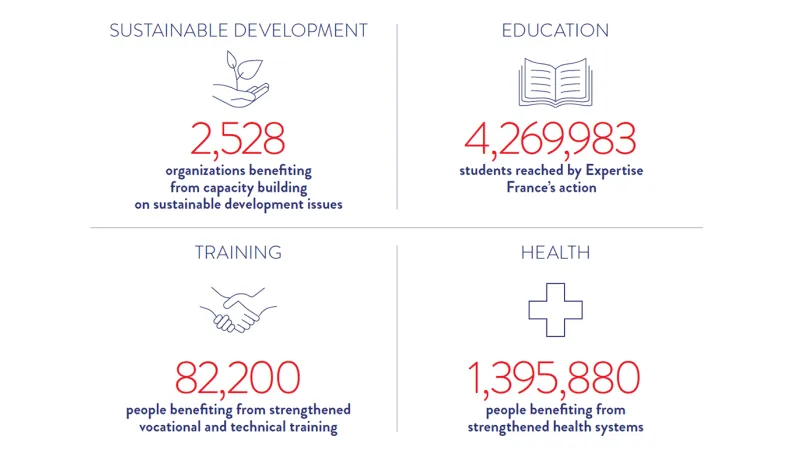
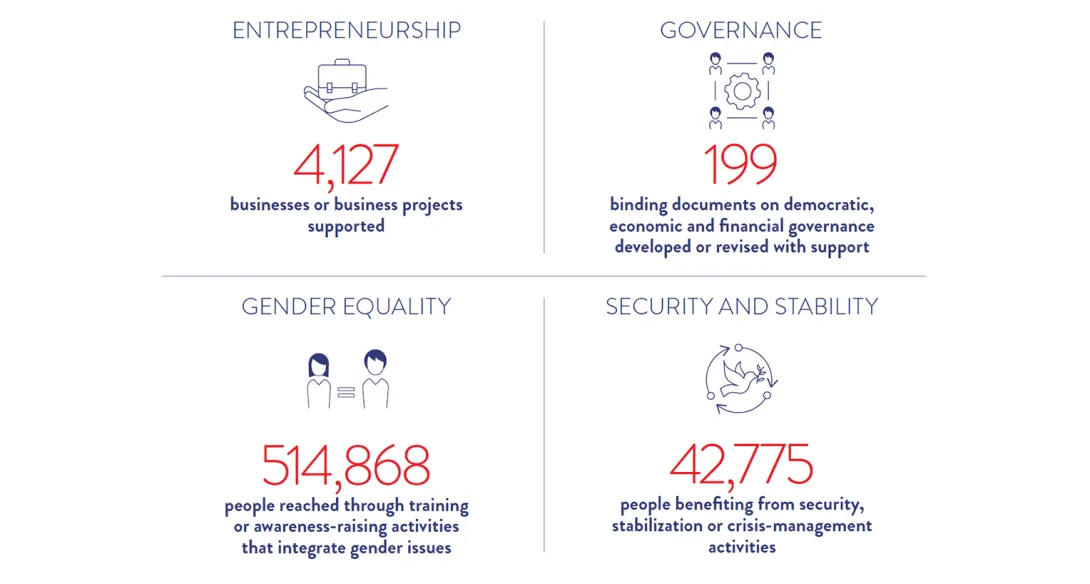
We use 32 aggregate indicators across six main areas of action. These are cross-cutting focus areas such as gender equality as well as health; human development; peace, stability and security; democratic, economic and financial governance; and climate, biodiversity and sustainable development. Here’s a review of the impact of our work in 2025:
- Health: 1,395,880 people benefiting from strengthened health systems
- Entrepreneurship: 4,127 businesses or business projects supported
- Governance: 199 binding documents on democratic, economic and financial governance developed or revised
- Basic education: 4,269,983 students reached by Expertise France’s action
- Gender equality: 514,868 people reached through training or awareness-raising activities that integrate gender issues
- Sustainable development: 2,528 organizations benefiting from capacity building on sustainable development issues
- Security and stability: 42,775 people benefiting from security, stabilization or crisis-management activities
COM indicators
Our Contract of Objectives and Means with the French government translates our political priorities and strategies into objectives, indicators and targets. This resulted in the following outcomes in 2025:
- 592 local, national and supranational public institutions received support on issues related to climate, biodiversity, circular economy, chemicals, waste, energy, and water and sanitation. This led to the development, strengthening and implementation of public policies in favour of environmental protection and the fight against climate change
- 36.7% of new projects (by volume of funding) contributed to environmental goals
- 85.7% of new projects financed by the French government focused on gender equality
- 1,143 education and vocational training institutions received support
- 2,746 African-based very small businesses/SMEs received support
- 2411 institutions received assistance in strengthening the rule of law, justice, human rights and public participation
- 51,3% of French-funded projects were carried out in Least Developed or fragile states
- 24.3% of revenue came from our in-country offices
How are these indicators collected?
The logical framework (logframe) approach was developed in the 1970s. It became the standard methodology among donors and other stakeholders in development cooperation by the late 1990s. This methodology presents project objectives in a logical, systematic manner, defines evaluation methods, and identifies external factors that may affect a project’s success.
Each project includes:
- Systematic evaluation of its expected contribution to sustainable development (biodiversity, climate, social cohesion, gender, etc.)
- Use of standardised tools and processes for effective and efficient project management
- Accountability mechanisms for regular reporting to recipients, partners, donors and the public
- Evaluation and knowledge-sharing exercises to analyse where current and finished projects succeed or fail so as to improve future project impact
- Audits to certify fund usage complies with donor regulations
Our impact in their words
Find out more about our impact with the testimonies of our international partners.
“Expertise France’s support in terms of business creation and my opportunity to join the Kedge Business School incubator were major assets. I was able to better understand the business I want to launch and fine-tune my business plan. What I love about this programme is that it connects all Comorian entrepreneurs who’ve received advice and support from Expertise France. The knowledge we were able to share with each other was invaluable and sparked off new ideas.”
- Comorian diaspora member and founder of Ushesa, a platform that connects home help professionals with members of the diaspora.

“With our partners’ support, we went from 33 to 480 ambulances. This was a major boost in terms of our transport capabilities. In terms of Expertise France, we received training in epidemiology so that we can respond to emergencies more effectively.”
- former Secretary General, Guinea Ministry of Health and Public Hygiene

Key figures
- 2,528 institutions received assistance in strengthening their capacities in the area of sustainable development
- 87,492 teachers and teaching staff trained on basic education issues in 2025
- 1,416 people trained on issues related to migration, diasporas or human trafficking in 2025
- 42,775 people benefiting from security, stabilization or crisis-management activities