Share the page
Keeping Education Systems Going in Crisis Areas
Published on
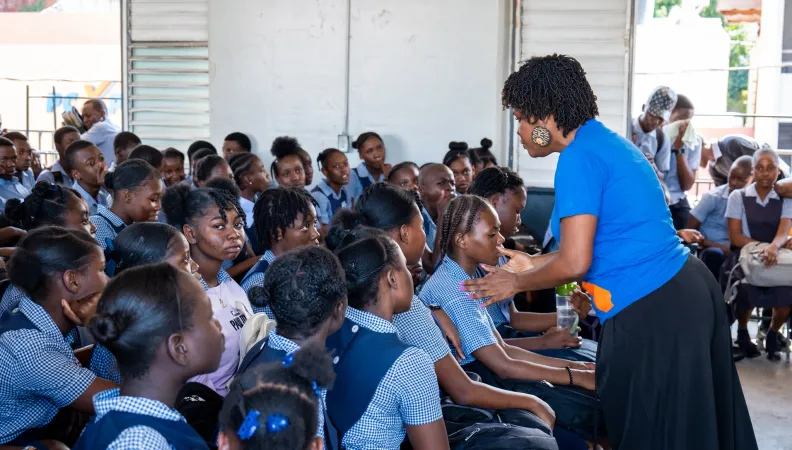
In 2025, the educational emergency in crisis areas was huge: the number of children and teenagers completely out of school reached nearly 400 million (more than half of whom were young girls) according to the NGO Plan International.
On the occasion of the International Day of Education on January 24, Expertise France is highlighting its commitment to educational communities facing conflicts, climate crises, and structural shortcomings.
In countries where security instability, climate shocks, and poverty compromise access to school over the long term, education acts as a lever for protection, social cohesion, and resilience. Through projects designed to address local realities closely in mind, Expertise France helps guide authorities, teachers, and communities in ensuring continuity in learning and in improving the quality of education, even in times of crisis. Haiti and Sudan, for example, face two very different situations but suffer from the same harmful effects on access to learning. Our commitment in these two countries involves strengthening their education systems via a complementary approach that takes into account both teachers and students. This is essential at a time when recent drops in funding allocated to education could push an additional 6 million children out of school by the end of 2026 (according to UNICEF).
In Haiti: school as a way to stabilize the social fabric and encourage community life
Haiti is undergoing a multidimensional and long-lasting crisis. Factors such as chronic insecurity, repeated natural disasters, and structural poverty deeply undermine the education system and threaten the schooling of thousands of children, especially girls. In response, Expertise France has been supporting the Ministry of National Education and Vocational Training (MENFP) and local actors for several years through ambitious programs focused on improving the quality of teaching, teachers’ skills, and the resilience of educational communities.
The "Education for a Common Future" project (€2.8 million) will soon be implemented in northeastern Haiti in early 2026. It will seek to strengthen the quality of education and social cohesion simultaneously, against a backdrop of serious vulnerabilities. The project provides for support over two years to public and contracted schools providing education from grades 1 to 9, as well as their teachers, managers, and students. One component will enhance the pedagogical and managerial practices of public educational actors, by improving their skills and their ownership of curricular reforms, in particular those of middle school level. A second component will back up the implementation of renewed pedagogical content directly in schools via local support for teachers and will consolidate the local governance of the education system, by positioning inspectors and managers of the Departmental Directorates of Education as real facilitators of change.
The ultimate goal is to ensure improved learning in mathematics and French, especially for young girls from disadvantaged backgrounds, as well as a more inclusive and innovative skills base.
This project, extended to other areas of the country, is a continuation of the “Avni Nou” project. This AFD-funded project of €9 million is being implemented in the central and western regions to sustainably improve the quality of education in public schools (grades 5 and 6), by placing teachers at the heart of the education system transformation.
Avni Nou, whose activities will end in 2026, works on three key aspects of the professional development of teachers: (i) strengthening their teaching capacities, (ii) establishing collective reflection on professional practices, and (iii) (re)constructing a rewarding social and professional identity. This social re-enhancement of the teaching profession marks a major challenge for the program, both as a goal and as an essential condition for quality education for Haitian children.
Since 2022, Avni Nou has supported 55 public schools, 155 teachers, 55 school managers (30% of whom are women), 25 education inspectors, 18 pedagogical supervisors, and nearly 5,500 students.
In addition, the project has provided training that systematically includes gender-equality issues for 141 teachers.
Against a backdrop of insecurity and frequent obstacles, Avni Nou, with the support of Haitian civil society organisations, has been able to mainstream the concept of education in crisis situations in order to finance innovative sub-projects mobilizing sport, culture, psychosocial support and artistic expression to preserve links with school.
With the association 4 Chemins, awareness-raising campaigns have been carried out through local media, in schools, and through advocacy groups. Theatrical performances on the themes of women’s rights and living together were organised in 12 partner schools.
Meanwhile, the association PRODEV has enabled 373 students – including 200 girls – to benefit from remedial classes (in math, French, and Creole), learning kits, and morning exchange circles. These actions have helped ensure educational continuity despite insecurity and natural disasters. In addition, 24 learning groups were created and 24 teachers trained in play-based learning and child protection.
Teaching conditions have also been improved thanks to targeted allocation of equipment: 150 digital tablets, school libraries (more than 5,600 books), as well as digital equipment to facilitate access to educational resources.
In Sudan, support for teachers to strengthen access to basic education
The EQUIP 2 project, which ended in December 2025 after five years of implementation, has fully contributed to structuring the education sector in Sudan at a time when the country has faced a multifaceted crisis that includes conflicts, lack of funds and equipment, and climate risks.
EQUIP 2, an extension of an initial phase that began eight years ago (EQUIP 1 2018-2021), helped build the capacities of university professors to pass on academic knowledge and professional skills to future teachers in faculties of education. In-service training modules implemented locally and regionally have also helped consolidate the disciplinary and crosscutting skills of current teachers, school principals, and inspectors, by taking into account the specific needs of students, especially those of girls and vulnerable groups. The project also contributed to professionalizing and internationalizing higher education, as well as to strengthening educational research through support to academic mobility and international academic cooperation.
On the gender theme, alongside its local partners, Expertise France has produced an analysis and an inventory of diversity in the teaching professions as well as an action plan to promote women’s access to positions of responsibility and to foster a more inclusive and equitable education system. In digital technology, Expertise France developed the “Sudanese Teacher Excellence Platform” in partnership with its Sudanese partners and Canopé, a French operator in public-teacher training. Designed specifically to meet the needs of teachers, this platform hosts and organises all the training manuals and resources created as part of the project. By facilitating online self-learning for teachers, it is a valuable innovation in Sudan.
Finally, in addition to its work alongside Sudanese institutions to sustainably develop the teacher-training system, Expertise France also coordinated humanitarian emergency activities.
- In Sudan, in partnership with the Norwegian Refugee Council, training sessions have been set up for teachers in the conflict-stricken regions of West Darfur, South Kordofan, White Nile, and Gedaref. The aim was to provide support enabling them to better meet the needs of the most vulnerable groups, such as girls, migrants, internally displaced persons, and refugees. The training also included a module on dealing with gender-based violence.
- In the neighbouring countries of Egypt, Chad, and Ethiopia, similar training has been set up in partnership with Plan International, the Jesuit Refugee Service, and Catholic Relief Services. As part of the regional refugee response plan, they have enhanced the capacities of teachers to take into account, in their teaching methodologies, the trauma suffered by refugee students.
This integrated, multi-stakeholder approach has ensured continuity of education for displaced students, providing an appropriate response to the regional dimension of the humanitarian crisis in Sudan.
In all, the project has enabled more than 2,200 teachers to strengthen their professional and disciplinary skills in Sudan, and 2,000 teachers to adapt to learning challenges in crisis situations in Sudan, Egypt, Ethiopia, and Chad, including 600 in Sudan alone. By extension, these measures have enabled more than 300,000 Sudanese students to benefit from a more resilient education system.
Branching out from the EQUIP 2 project, an action plan has been developed with the EU-funded Regional Teachers Initiative for Africa (RTIA) Facility, in consultation with the National Centre for Teacher Training (NCTT) in Sudan. This action plan takes up a number of analyses and recommendations developed in the white paper under the EQUIP 2 project. Its implementation will help mobilize experts who will support the NCTT and the Ministry of Education both on the initial training and on the in-service training of teachers. Core aspects of the action plan include harmonizing teacher-training programs, strengthening coordination of institutions in charge of teacher training, and integrating an approach to the professional development of teachers based more on classroom practices.
On the same topic
PAIRE - Institutional Support Project for Education Reform in Mauritania
Ongoing
2023 - 2026
Funders : European Union
Agustine
Ongoing
2024 - 2028
Funders : European Union, Ministry for Europe and Foreign Affairs of France, UNESCO, UNICEF
Africa Connect Digital Campus
Ongoing
2025 - 2029
Funders : European Union, Ministry for Europe and Foreign Affairs of France
In the news
Back to school: for secondary education that takes into account everyone’s needs
Published on September 2, 2026