Share the page
Resilience Starts at Home: disaster-risk planning and action at household level
Published on
The 13th of October is the International Day for Disaster Risk Reduction. Each year it reminds us that it’s always cheaper to prevent than to repair, and that building resilience should start well before a crisis strikes.
The theme of the 2026 edition is “Resilience Starts at Home”, making the household the basis for planning. This choice is not insignificant: the home is one of our most intimate spaces; a place of wide-ranging vulnerability; and the most practical place where, at an individual level, we can build sustainable resilience. This is the approach adopted by Expertise France’s initiatives in Iraqi Kurdistan, with capacity building for local actors as well as the general population.
The home: the key place for risk prevention and preparedness
At Expertise France, we recognise that risk reduction must be people-focused. The Sendai Framework (2015–2030) emphasises that policies, systems and investments must be designed to meet the needs and capacities of individuals, but with the acknowledgement that impacts from events are not experienced the same way by different people. Further, no space embodies this reality better than the home: it’s the place where we live, sleep, take refuge and feel safe. Our housing thus multiplies or mitigates risks depending on where it is located, how it is built and how it is maintained. For example, if our home is located in a high-risk area and built without meeting earthquake-resistant or flood-proof standards, it is all the more vulnerable should an event occur.
We have observed that many structural inequalities can be found at the household level. Women, children, older people, people with disabilities and low-income households may be more vulnerable to disaster impact. These vulnerabilities are linked to structural inequalities, especially in access to housing and resources, mobility, land tenure and decision-making power. Care responsibilities, which are often disproportionately borne by women, can also limit households’ ability for disaster anticipation, evacuation or recovery. For Expertise France, this means that prevention, preparedness and response measures carried out by civil-protection and risk-management bodies must be better coordinated and more inclusive, taking into account the specific needs of all social groups.
Finally, global progress in early warning systems means that a growing number of people can receive emergency alerts. However, an alert is only effective if it reaches all members of the household in an accessible and understandable form. It’s thus crucial to bridge the gap between receiving an alert and taking appropriate action at the household level. This can be achieved through accessible risk communication, inclusive evacuation planning and recognition of the care responsibilities often borne disproportionately by women in times of crisis. That’s why this complete alert-to-action chain forms part of our offering. It includes support for early warning systems, public awareness-raising, simulation exercises, risk communication and the fight against disinformation.
Bolstering risk preparedness in Iraqi Kurdistan
An example of this link between awareness-raising, material preparedness and local infrastructure can be seen by the Disaster Risk Management for the Kurdistan Region of Iraq project, funded by the European Union and implemented by Expertise France. This project is carried out in the governorates of Erbil, Duhok and Sulaymaniyah, in coordination with the Joint Crisis Coordination Centre (JCC) and the Department of Civil Defence of the Kurdistan Region of Iraq. It demonstrates how, at the regional level, people-focused disaster-risk reduction principles can be translated into action:
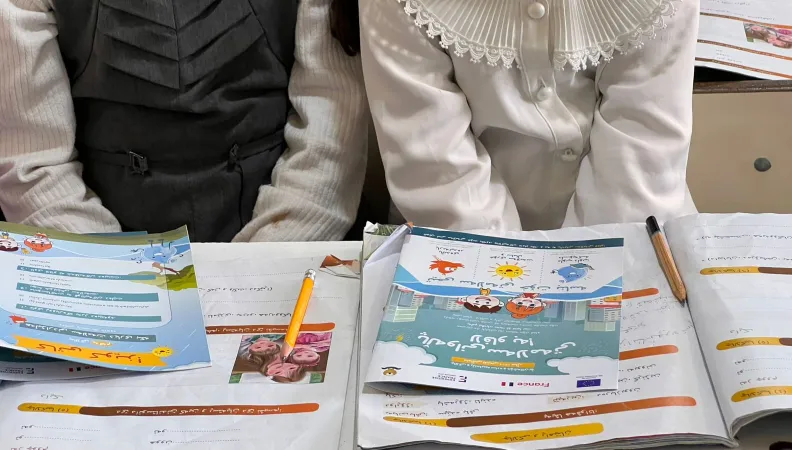
- Direct awareness-raising and distribution of essential supplies: in March 2026, around 400 members of various communities and 1,500 pupils took part in awareness-raising sessions. This action was supplemented by the distribution of 1,900 emergency kits to households, including first-aid supplies, lighting and signalling devices, waterproof document covers and personal protective equipment.
- Building local capacity: between August and October 2025, 177 volunteers (117 men and 60 women) from the Community Response Teams and the Rapid Response Units were trained as trainers in community awareness-raising on flood risks. They now make up a decentralised network of independent facilitators.
- Standardisation of messages: two operational manuals have been drawn up: one for community sessions and the other for school-based sessions. They cover types of flooding; preparatory measures before, during and after an event; and participatory facilitation techniques.
- Expansion of geographical coverage: a mobile classroom capable of accommodating 22 to 24 participants per session was delivered to the JCC in June 2026 so that it can reach remote or underserved areas.
In the news
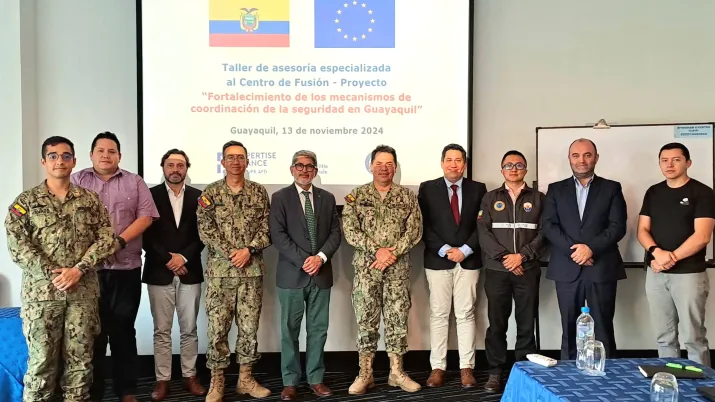
In Guayaquil, strengthening port security and intelligence to combat drug trafficking
Published on October 2, 2026
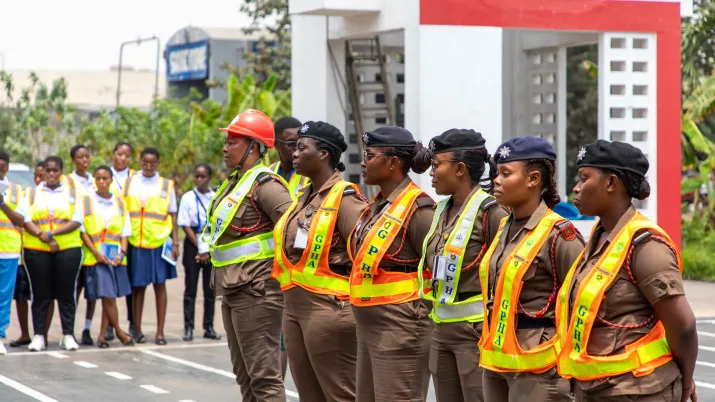
EnMAR Voices: A Podcast to Give Women a Voice in Maritime and Port Security
Published on March 10, 2026
On the same topic
The Phénix Project: strengthening civil protection in Haiti
Ongoing
2024 - 2027
Funders : Agence Française de Développement
Strengthening nuclear safety in Africa
Ongoing
2024 - 2028
Funders : European Union, Government of France