Share the page
In Guayaquil, strengthening port security and intelligence to combat drug trafficking
Published on
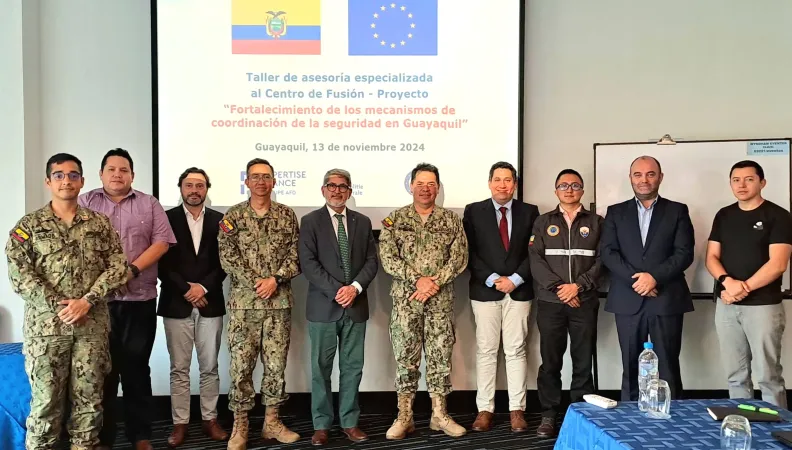
In Ecuador, Guayaquil has become one of the main departure points for cocaine bound for Europe. In response to this transnational threat, the EUFORT-EC project, co-funded by the European Union and France and implemented by Expertise France, is strengthening coordination among Ecuadorian institutions and enhancing security across the port ecosystem.
Ecuador is currently facing a growing threat from drug trafficking and organised crime, with Guayaquil emerging as one of its main hubs. The country’s port system plays a strategic role in the trafficking of illicit drugs to Europe. In response to this transnational threat, cooperation between Ecuadorian institutions and their European partners is essential to better detect, prevent and combat these activities.
It is in this context that EUFORT-EC – Strengthening Security Coordination Mechanisms in Guayaquil was launched. Co-funded by the European Union and France and implemented by Expertise France, the project aims to improve coordination and the effectiveness of institutions involved in the fight against organised crime and to reduce drug trafficking between Ecuador and the European Union. Its action is based on two complementary areas: strengthening intelligence sharing and enhancing the security of the port system and its logistics chain.
Improving intelligence sharing to combat trafficking more effectively
One of the project’s main achievements is the establishment of an Intelligence Fusion Centre, which has been operational since 1 September 2025 and was officially inaugurated in January 2026. To enable the Centre to operate effectively, its facilities were refurbished and equipped, while several security and information-management applications and intelligence platforms were deployed. Centre staff also received training in intelligence, the fight against organised crime and the use of specialised tools.
The Centre enables information from different Ecuadorian institutions to be cross-referenced and strengthens information sharing with international partners. A study visit was organised to the Maritime Analysis and Operations Centre – Narcotics (MAOC-N), an international agency based in Lisbon, and two memoranda of understanding were signed during the Centre’s inauguration. Its operational outputs are now shared with European, national and regional partners. A communication channel has also been established with Europol’s unit in Ecuador, while exchanges with neighbouring countries such as Colombia are being strengthened.
To date, the Centre has produced more than 30 intelligence reports, alerts and information bulletins. This work has contributed to initial concrete operations, including the arrest of three people involved in the contamination of containers in the ports of Guayaquil and the seizure of two speedboats used to approach merchant vessels in the Gulf of Guayaquil.
Securing ports by mobilising the entire logistics chain
The fight against drug trafficking also takes place within the port ecosystem itself. EUFORT-EC is therefore supporting stronger coordination between national authorities and private-sector stakeholders to better secure strategic points along the logistics chain. Public-private dialogue mechanisms have been developed, and a Joint Security Platform, bringing together in particular the security managers of port terminals, has been established to coordinate and monitor priority actions.
Experts from the Port of Antwerp-Bruges and the Belgian Federal Police also conducted an audit of five terminals in Guayaquil. Their recommendations, tailored to each terminal, focus in particular on strengthening port security, ensuring compliance with the International Ship and Port Facility Security Code (ISPS Code), and implementing a so-called “barrier” security model.
A “crime script” tool was also developed and provided to Ecuadorian authorities to improve their understanding of the operating methods of criminal networks and monitor how they evolve. Finally, two surveillance drones were handed over to the coastguard and police, together with specific training for their operators.
Cooperation also relies on sharing experience across the Atlantic. Study visits were organised to Antwerp, MAOC-N and Le Havre to facilitate exchanges on countermeasures implemented against drug trafficking and strengthen information flows with the Intelligence Fusion Centre.
This mobilisation of the entire logistics chain is further supported by “Alerta Anónima”, a platform enabling suspicious behaviour or incidents to be reported securely and anonymously. Accessible without creating an account or providing personal data, it provides an additional tool for strengthening prevention and early warning mechanisms. It is accompanied by a communication strategy aimed at raising awareness among port workers, carriers and logistics operators, reducing concerns about retaliation and strengthening a culture of reporting.
By strengthening intelligence, fostering cooperation between public and private stakeholders and mobilising the entire port ecosystem, EUFORT-EC is helping to build a collective response to a threat that, by its very nature, transcends borders. “A safe port: we all build it together” – a principle that encapsulates the ambition of the project in Guayaquil.
In the news
EnMAR Voices: A Podcast to Give Women a Voice in Maritime and Port Security
Published on March 10, 2026
In Southeast Asia, providing long-term support to the circular economy, health and security
Published on October 6, 2025
on the same topic
EnMAR+ – Enhanced Maritime Action in the Gulf of Guinea, Red Sea and Western Indian Ocean
Ongoing
2026 - 2028
Funders : European Union
HERITRACE - Strengthening the fight against trafficking in cultural property
Ongoing
2026 - 2029
Funders : European Union

Digital Economy, E-Commerce, E-Payments and Public E-Services Programme (EU-EAC DEEP)
Ongoing
2025 - 2029
Funders : European Union, German State, Ministry for Europe and Foreign Affairs of France, Estonian Ministry of Foreign Affairs