Share the page

Disaster Risk Management in Iraq
Project
Published on
-
Project start date
-
Status
Ongoing
-
Project end date
-
-
Financing amount (Euro)
-
1.54m
-
Country and region
-
Iraq, Middle East
-
Funders
Through this project, Expertise France is supporting natural disaster response capabilities in the Iraqi Kurdistan region, by helping to increase the resilience of Iraqi society.
Iraqi Kurdistan: A region vulnerable to flood and fire risks
While the Iraqi Kurdistan region only covers 10% of Iraqi territory, it concentrates a significant share of natural disaster risks. Several factors contribute to these major risks, including its mountainous terrain, extreme weather conditions, and the impact of human activities in densely populated and sprawling urban centres. Flash floods, as in Erbil in 2021, and torrential rain, as in Dohuk in March 2024, have resulted in the loss of lives and extensive damage to infrastructure. Furthermore, there are an increasing number of urban fires, largely due the deficient power grids, which are particularly vulnerable during hot and dry summers.
As there are no specialised training centres, the emergency services struggle to cope with these disasters. The Civil Defence rescue teams do not have appropriate equipment and only have limited access to certain data, yet they are essential to their action. In addition, there is no early warning system or centralised emergency number to alert populations in the event of a crisis, and the emergency plans remain inadequate, or are even non-existent in some regions.
The combination of these factors makes the region vulnerable, requiring increased efforts to strengthen prevention, improve infrastructure, and help people better prepare for the growing risk of natural disasters in the Iraqi Kurdistan region.
Strengthening the response capabilities of Iraqi Civil Defence services
The project aims to strengthen disaster response capabilities in the Iraqi Kurdistan Region (KRI). It focuses on reducing the human losses, injuries and economic losses caused by disasters, especially particularly flash floods and urban fires. It supports the main civil protection and emergency management institutions in the Kurdistan Region of Iraq, strengthening their ability to anticipate risks and respond effectively to emergencies.
The main activities include:
- Providing specialised equipment for water rescue and firefighting
- Strengthening operational capabilities through targeted training programmes
- Improving psychological support services for vulnerable groups affected by disasters
In addition, the project also aims to strengthen disaster prevention and preparedness systems by building capacities in risk assessment and risk mapping, improving emergency preparedness and contingency planning, and implementing public awareness campaigns.
By addressing both disaster preparedness and emergency response, the project contributes to strengthening the resilience of communities in the Kurdistan Region of Iraq and enhancing their capacity to anticipate, prepare for and respond to future disasters.
Improving training for emergency services
Training for Civil Defence personnel and Rapid Response Units (RRU) is a key component of the project. The objective is to improve their competencies in three key areas: water rescue, firefighting in confined spaces, and psychological support for vulnerable groups affected by disasters.
Water rescue
Seven Kurdish rescue workers were selected to take part in specialised training in France. Working alongside firefighters from SDIS 34 in Gignac, they received practical training in swift-water rescue techniques and boat handling in strong currents.
Upon returning to the Kurdistan Region of Iraq, they became trainers themselves, transferring the skills and knowledge local rescue teams under the supervision of SDIS 34 firefighters. Through this program, a total of 76 rescue workers were trained, strengthening local flood preparedness and emergency response capacities.
Firefighting in confined spaces
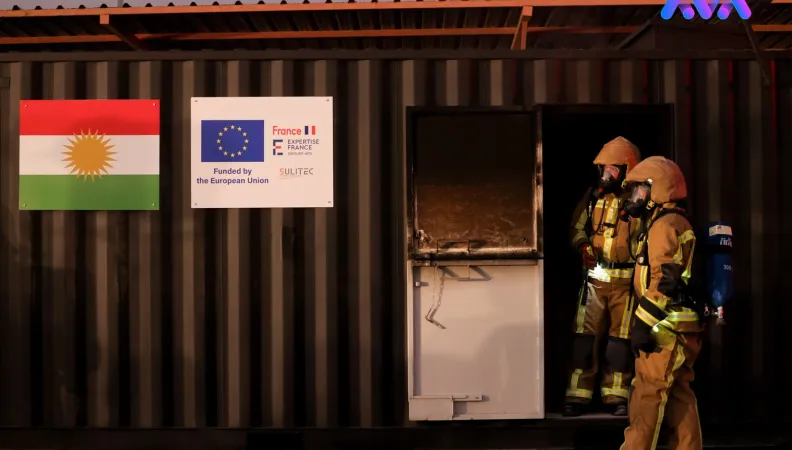
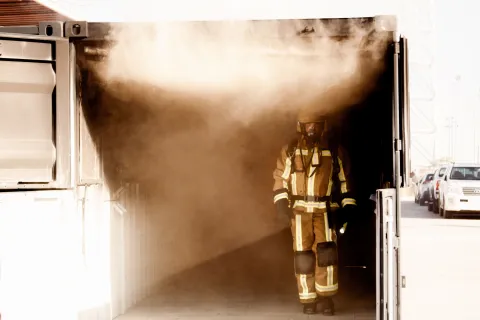
A “fire box” (container fire simulator) will be delivered to Kurdistan to organise a training-of-trainers session on how to use it. Ten Kurdish firefighters received specialised training in urban firefighting techniques delivered by SDIS 34 firefighters. Several additional training sessions were subsequently organised at the Civil Defence Training Institute near Erbil. This component resulted in the training of 110 firefighters
 Simon Raulin
Psychological support for vulnerable groups
Psychological support for vulnerable groups affected by disasters will also be addressed through the organisation of training-of-trainers sessions.
A total of 80 volunteer first responders from partner institutions received training on empathy, resilience strategies, psychological preparedness, and awareness of community-based support resources.
In addition to these training sessions, the project will also prepare three specific curricula and practical guides for first responders. These documents will provide benchmarks to improve the safety and efficiency of emergency interventions in the event of floods and urban fires. They also cover psychological support.
Through these training sessions and educational tools, the project is helping to strengthen disaster response capabilities in Iraqi Kurdistan, while ensuring that rescue teams are better prepared to handle the growing risks.
Sustainable Development Goals
SDG16 - Peace, justice and strong institutions
Promote just, peaceful and inclusive societies
On the same topic
Strengthening nuclear safety in Africa
Ongoing
2024 - 2028
Funders : European Union, Government of France