Share the page

EU4DecentWork - Promoting decent work and the formalisation of employment in Mexico
Project
Published on
-
Project start date
-
Status
Ongoing
-
Project end date
-
-
Financing amount (Euro)
-
2m
-
Country and region
-
Mexico, The Americas
-
Funders
-
Partners
The project aims to reduce the informality of work in Mexico by strengthening access to social protection and the formalisation of employment.
Diagnosis of labour informality in Mexico: challenges and consequences
Labour informality represents one of the primary challenges facing Mexico's labour market, despite Mexico’s sustained economic growth and increasing integration into the global economy.
+30 million people affected by labour informality in Mexico, accounting for 55% of the population aged 15 and older (INEGI - Q4 2025).
This phenomenon limits access to social security, reduces productivity, and hinders inclusive economic development. Addressing it requires comprehensive public policies that integrate labour, economic, and social protection dimensions, tailored to specific contexts as the phenomenon is multi-causal.
- Firstly, it is the result of a combination of economic, political and social factors.
- Secondly, it mainly affects certain vulnerable groups such as women, young people, domestic workers and the elderly. Among these groups, the first two, particularly in rural areas and in the south of the country, are the most exposed to precarious and informal forms of employment.
These often unstable and low-paid working conditions are particularly prevalent in agriculture, commerce and construction. Informal work has considerable consequences, not only for the workers concerned, but also for the economy as a whole.
- On the one hand, informal workers are exposed to higher levels of poverty, due to the precariousness of their income and the absence of social protection, such as social security and pension schemes.
- On the other hand, informality affects the overall productivity of the economy, undermines competition on the markets, and compromises the sustainability of public finances and pension systems.
EU4DecentWork: promoting labour formalisation and social protection
Within this framework emerges the EU4DecentWork project (European Union for Decent Work), which aims to promote conditions for labour formalisation and decent work for everyone in Mexico.
Through this project, a series of technical assistance measures were designed to provide an equitable response to the needs of Mexican workers in a number of areas: creation of quality jobs, access to social protection especially for the unemployed and informal workers, and a raised public awareness among trade unions, employers and workers of the benefits of formal employment.
The project is structured around four primary pillars:
- Strategic Analysis for Labour Formalisation;
- Capacity Building for institutions responsible for labour, economic, and social security policies;
- Tailored Regional Interventions to adapt to the realities of local labour markets and productive sectors;
- Innovative Pilot Projects with replication and scaling potential, aimed at testing concrete solutions for employment formalisation.
The project aligns with the National Development Plan 2025–2030 and the Mexico Plan. Furthermore, the project is part of the European Union's Global Gateway agenda, contributing to it by fostering a more favourable environment for investment, productivity, and corporate competitiveness, while simultaneously driving sustainable development and social inclusion.
A multi-actor dialogue platform with territorial and sectoral focus
The success of the EU4DecentWork project depends to a large extent on the establishment of a multi-actor dialogue, bringing together a wide range of public, private and civil society stakeholders. This dynamic of exchange is essential to ensure a concerted and inclusive approach, capable of responding to the multiple challenges of local formalisation of employment.
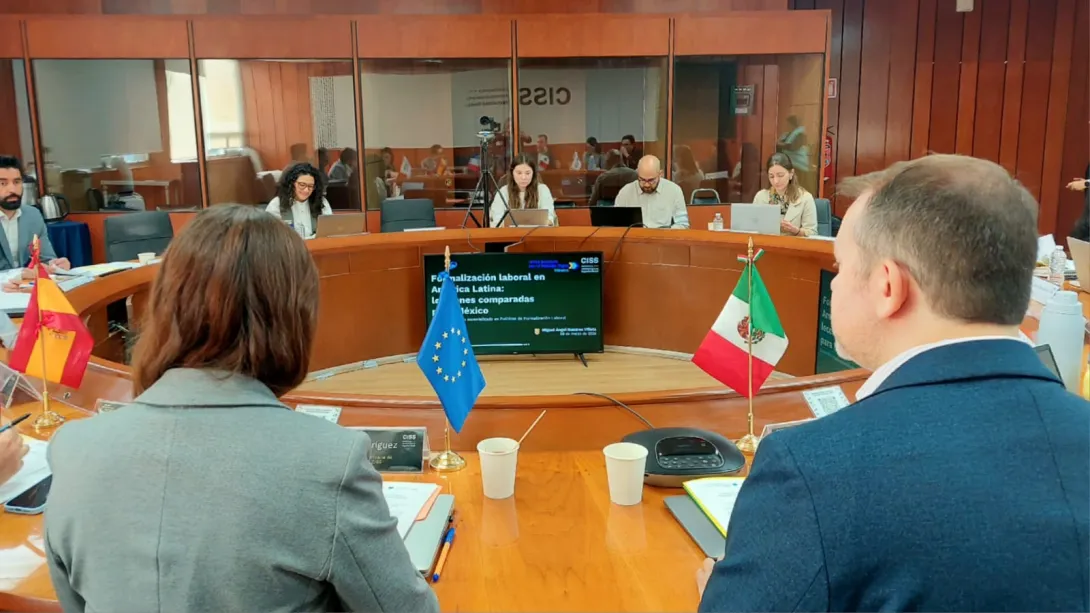
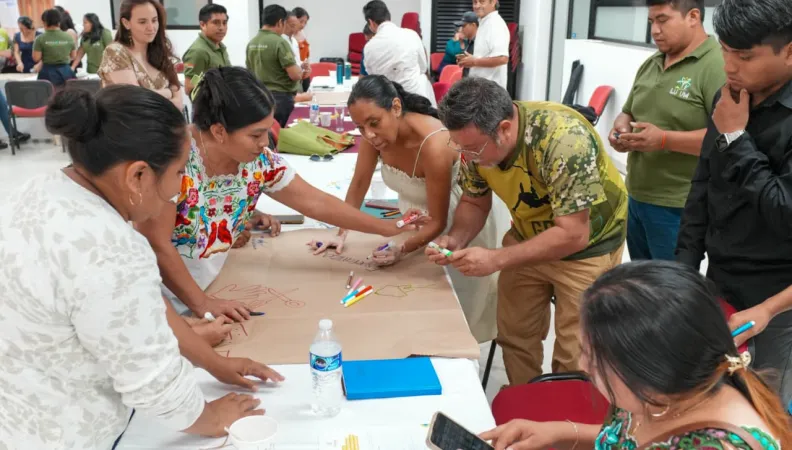
An example of this is the territorial round-tables for labour formalisation, decent work and productivity. They allow public, private, and civil society actors to build shared diagnoses, identify priority challenges, and agree upon concrete solutions tailored to local and sectoral realities.. They are operational across five strategic productive corridors, selected for their economic relevance, integration into global value chains, and potential to generate formal employment:
- Bajío Corridor (Querétaro and Guanajuato): automotive, auto parts, and distribution sectors.
- Maya Corridor (Yucatán and Quintana Roo): sustainable tourism sector and associated major infrastructure projects.
- Mexico City Metropolitan Corridor (CDMX and State of Mexico): construction sector.
- Interoceanic Corridor of the Isthmus of Tehuantepec (Oaxaca and Veracruz): agro-industrial and logistics-commercial sectors.
- Pacific Corridor (Jalisco and Michoacán): agro-industrial sector.
Through this collaborative platform where each stakeholder plays a decisive role, EU4DecentWork is ensuring that formalisation policies are both inclusive and adapted to Mexico's territorial economic and social challenges.
A strong public-private cooperation strategy to promote decent work
The EU4DecentWork strategy with the private sector focuses on fostering responsible business conduct and supporting corporate initiatives related to due diligence and labour standards. The project aims to facilitate the participation of private sector companies in efforts to promote decent work and in multi-stakeholder dialogues for the formalisation of employment in prioritised sectors and value chains.
To mobilise the private sector, the project has initiated a process in collaboration with European Chambers of Commerce in Mexico, through a technical monitoring committee.. Key actions include conducting a participatory diagnostic study on the economic, social, and institutional barriers to labour formalisation in prioritised sectors and value chains, as well as identifying best business practices. Through the project, we:
- contribute to developing policy proposals and best practices to promote decent work and labour formalisation from a private sector perspective;
- implement a training programme on European standards of due diligence and responsible business conduct, with a focus on human capital management;
- work closely with the States Commission of Human Rights in the Northern Border to promote a label for companies engaged with human right and decent work policies.
In addition, we developed over the past months, strong relationship with key Mexican chambers, which have an active participation in the territorial and sectorial round-tables. Some leading companies such as Michelin, Pirelli, Volkswagen, Hilton, Hyatt, Vinci, are also involved in the project through the round-tables and some concrete pilot projects to act as champions and showing best practices to the rest of their sector.
This approach enhances the private sector's role in formalising employment, promoting decent work, and facilitating dialogue with public authorities.
Towards an inclusive society: protecting vulnerable groups
Social cohesion is at the heart of the EU4DecentWork project's priorities, with a particular focus on vulnerable groups who are often excluded from social protection schemes and formal employment opportunities. Women, young people, domestic workers, agricultural workers, as well as self-employed and digital platform workers are among those most affected by this phenomenon. The project is committed to extending social security coverage to these categories in difficulty.
 © Claire Arenales del Campo
It also actively supports CSOs working to promote the professional integration of vulnerable groups. For instance, the Mexican youth can benefit from mentorship, receive trainings in soft and technical skills and be integrated more easily into the labour market through internships in leading companies and inclusive recruitment events and job fairs.
Resources for download
Operational results: strengthened training and new public policy reforms
To date, thanks to the technical assistance provided, the project has supported four key public policy reforms at the federal level to promote labour formalisation:
- Formalizing agricultural employment through the creation of the Labour Certificate for Agro-Exportation;
- Simplifying procedures and introducing incentives for self-employed workers and micro and small enterprises;
- Promoting labour productivity and skills development in priority sectors, including a sectoral vocational training governance mechanism and a pilot initiative in the automotive sector in the Bajío region;
- Strengthening labour inspection strategies through coordinated inspections, value-chain approaches, and tools targeting informal employment.
The project also strengthened institutional capacities through a specialised training diploma for labour inspectors, and the training of National Employment Service trainers to build internal training capacity.
At the federated state level, the project promoted initiatives tailored to local needs, focusing on inclusive recruitment and employment support, skills development for formal employment and decent work, strategies to strengthen compliance with labour regulations, and administrative simplification for business registration and improved access to registration services in remote areas.
Key figures
- 19 Mexican institutions benefitted from the 28 technical assistance missions carried out by 6 European institutions
- 50 thematic meetings held within the framework of 5 territorial round-tables.
- 200 labour inspectors and 120 public servants of the Social Security Institute trained
- 19.3 million of potential beneficiaries in Mexico working informally within the project's priority states
Watch our conference on decent work
#RDVExpertise Decent Work
Watch the replay of the programme broadcast on 28 May 2026 on the challenges involved in promoting decent work and social justice, filmed in Mexico City!
Online
In the news
Promoting decent work in a context of transition in Latin America
A core facet of France’s international action is decent work, as promoted by the International Labour Organization (ILO). At Expertise France, this translates into tangible support for public policies...
Published on May 28, 2026

Discover other projects

SOCIEUX+ - EU expertise on social protection, labour and employment
Ongoing
2024 - 2027
Funders : European Union, Government of France, Belgian State, Spanish State

Social Security Cooperation in Colombia
Ongoing
2022 - 2026
Funders : Agence Française de Développement