Share the page

Sharaaka 2: Strengthening the criminal justice system in Libya
Project
Published on
-
Project start date
-
Status
Ongoing
-
Project end date
-
-
Financing amount (Euro)
-
1m
-
Country and region
-
Libya, Africa
-
Funders
-
Partners
-
Criminal Research and Training Centre in Libya

The Sharaaka 2 project aims to strengthen the capacities of the Public Prosecutor's Office staff in order to improve the efficiency of the Libyan judicial system and support the sustainable and effective development of its role in serving society.
Sharaaka 2: Building the capacity of the Public Prosecutor’s Office in Libya
Sharaaka 2 seeks to reinforce the capacities of the Libyan Public Prosecutor's Office by developing specialised knowledge and skills to address crimes related to human trafficking, and associated legal challenges.
To achieve this objective, the project focuses on establishing a sustainable training infrastructure, strengthening language proficiency to improve communication with illegal migrants, and promoting international knowledge exchange.

The project builds on the achievements of Sharaaka 1, implemented between 2024 and 2025, by expanding and deepening capacity-building activities. It is funded by the French Government and implemented by Expertise France, in partnership with the Criminal Research and Training Centre (CRATC).
For further information
Various actions to strengthen the Libyan criminal justice system
Sharaaka 2 delivers comprehensive support to the criminal justice system in Libya. We work alongside the Criminal Research and Training Centre to:
- Strengthen and institutionalise judicial capacity to address crimes related to human trafficking.
- Digitalise and standardise case management processes in order to improve efficiency and reduce processing time.
- Enhance the alignment of legal frameworks with international standards, and improve cross-border cooperation on migration and trafficking cases.
Four lines of action
Assessment of needs
- Creation of a task force bringing together Libyan stakeholders and experts to collaboratively design project activities.
- Development of a training roadmap focused on case studies and practical scenarios.
- Identification of digitalisation needs through the development of an action plan for the digitalisation of Standard Operating Procedures (SOPs) within CRATC.
- Organisation of an official launch event to present the project objectives to key partners.
Capacity Building and Knowledge Transfer
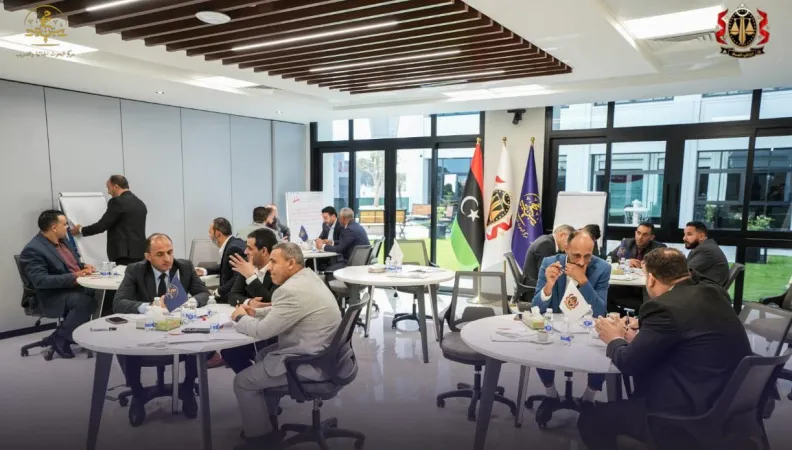
Judicial capacities to address migration and human trafficking are strengthened and institutionalised through a Training of Trainers (ToT) approach. A dedicated pool of trainers is established and trained on a range of thematic areas:
- Training Engineering and Adult Learning: delivery of training sessions for two groups of 15 participants each.
- Advanced Thematic Specialisation:
- Strengthening expertise in trafficking in human beings and improving victim identification abilities.
- Developing competencies in investigation, prosecution, and digital evidence management.
- Enhancing understanding of transnational and cross-border case management and coordination.
- Applying acquired knowledge through practical exercises and adapted instructional techniques.
Digital Transformation and Operational Efficiency
- Creating a digital case management system through the development of a secure, interactive and fully operational platform designed to enhance data protection and facilitate regional and international cooperation.
- Strengthening IT support teamsby providing specialised expertise to technical staff.
- Training Judicial staff training to ensure effective use of newly developed digital tools.
- Developing Standard Operating Procedures: Creation of at least one formal SOP.
Strategic Collaboration
International cooperation on human trafficking is enhanced and better aligned.
- Support for a mutual cooperation agreement through the establishment of a formal partnership between CRATC and the École Nationale de la Magistrature (ENM) in France.
- Organisation of two international study visits to migrant transit or destination countries in order to benefit from international expertise and good practices.
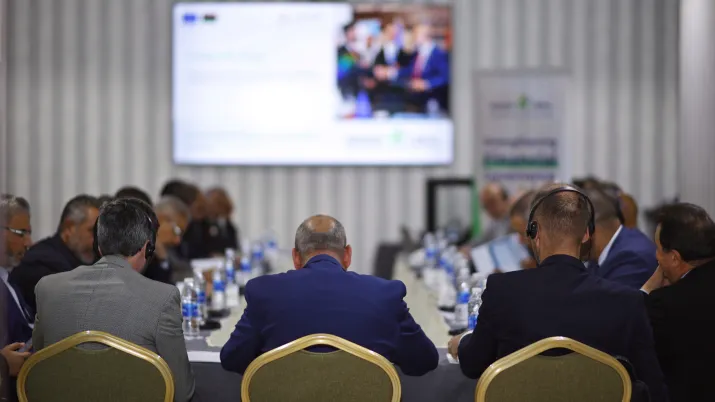
- Organisation of a regional seminar entitled "Strengthening Action against Trafficking in Human Beings in Migration Contexts" at CRATC premises in Tripoli.
Our Collaborative Approach with CRATC
Expertise France adopts a practical and results-oriented methodology designed to generate lasting institutional impact. Rather than focusing solely on static reporting activities, our approach centres on building robust systems, enhancing professional practices, and fostering shared ownership with CRATC.
Core Pillars of the Partnership
- Co-Design ("With CRATC, not for CRATC"): all activities, tools, and priorities are developed collaboratively to ensure strong ownership and long term sustainability of the project outcomes for the CRATC..
- Practical learning: training activities are grounded in real-life situations through case studies, mentoring, simulations, and peer exchanges to ensure direct applicability to daily operations.
- Institutional strengthening: Our goal transcends one-off events. We focus on reinforcing training systems, clarifying operational procedures, and enhancing internal technical capacities.
- Operational follow-up: we maintain a proactive monitoring system to track progress, address challenges early, and provide data-driven support for critical decisions.
Sustainable Development Goals
SDG16 - Peace, justice and strong institutions
Promote just, peaceful and inclusive societies
Our projects in Libya
Projet CT-JUST
Closed
2022 - 2026
Funders : European Union, Ministry for Europe and Foreign Affairs of France

In the news
Justice: Support for strengthening judicial and legal systems
This week was marked by two important events: the meeting of the “International Justice Network” coordinated by the Delegation for European and International Affairs of the Ministry of Justice, and Ex...
Published on December 8, 2023