Share the page
From National Framework to Local Action: supporting the transformation of waste management in Cameroon
Published on
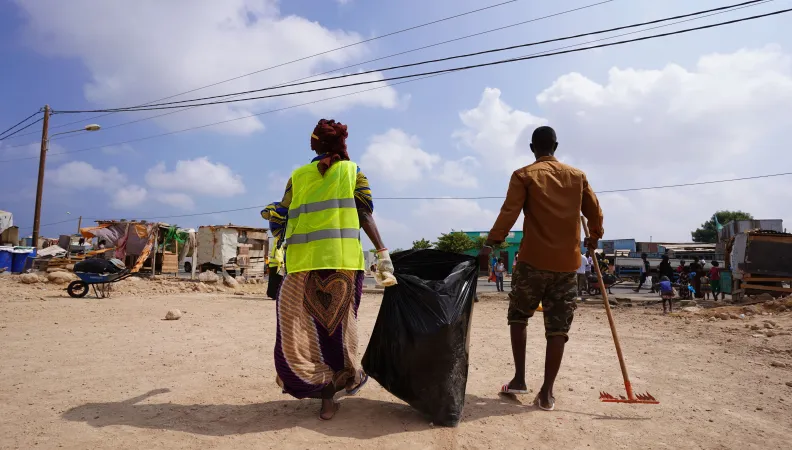
Through the EU-funded Urban Platform Project in Cameroon (PUC), Expertise France has supported the Cameroonian authorities in establishing the national policy and strategy on hygiene, sanitation and management of non-hazardous solid and similar household waste. Our support combines governance, local capacity building and multi-stakeholder engagement, ranging from the development of a national strategic framework to capacity building for local authorities and the testing of solutions in the Yaoundé 5th District Municipality.
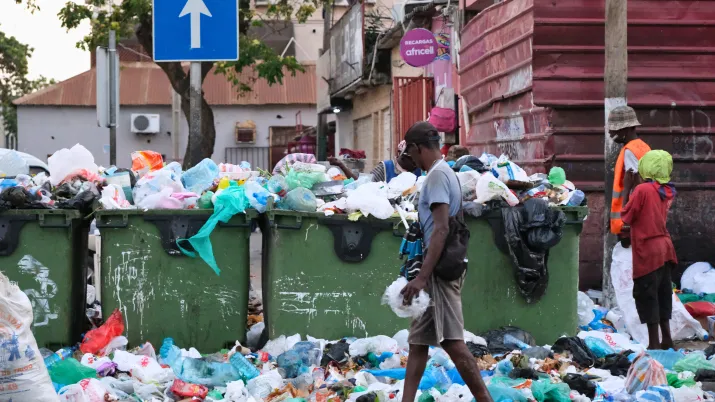
Urban waste management has become a top issue for Cameroonian cities, as highlighted in March 2025 by the #PoubelleChallenge, a movement that originated on social media, in which residents, artists and public figures photographed or filmed themselves in front of piles of rubbish in Yaoundé and Douala to criticise the failures of the refuse collection service.
The process had actually started up as early as 2024 within the Plateforme des acteurs de l’urbain, a multi-stakeholder consultation forum facilitated by the PUC Project. At its second meeting, which focused on waste management, the participants had drawn up several recommendations and decided to make it a priority area to guide some of the Project’s activities in 2025.
The National Forum on the Management of Urban Waste Resources, held on 6 and 7 May 2025 in Yaoundé, marked a new phase: it signalled a paradigm shift by which waste should no longer be viewed merely as a nuisance to be disposed of, but as a resource that can contribute to the circular economy, wealth creation and employment.
Amongst other points, the roadmap adopted at the Forum sets the target of achieving 100 per cent collection of household and similar waste and 25 per cent recovery by 2035. It also aims to increase the share of the circular economy to 2 per cent of GDP by 2030 and to create 10,000 urban jobs in the recovery sector.
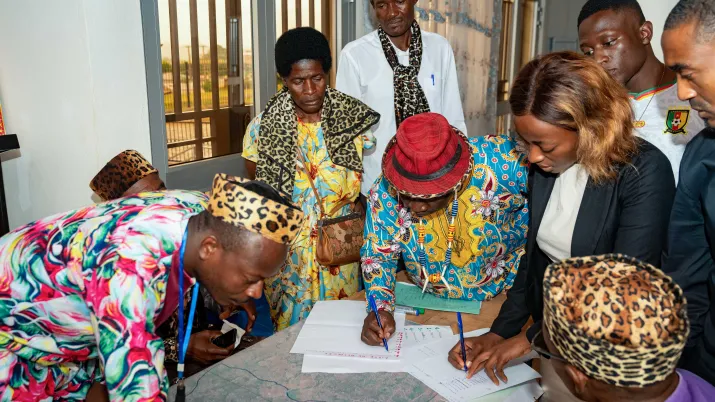
The support provided by Expertise France culminated on Friday, 18 September, when Mrs Célestine Ketcha Courtes, Minister for Housing and Urban Development, was officially presented with the National Policy and National Strategy drawn up under the leadership of her ministerial department. This event was attended by His Excellency Mr Joseph Dion Ngute, Prime Minister, and Mr Jérémie Pellet, Chief Executive Officer of Expertise France.
Developing a strategic framework to support the roadmap
In May 2024, the Ministry of Housing and Urban Development (MINHDU) officially requested support from Expertise France to develop a national policy to deal with sanitation problems. This support took the form of technical assistance aimed at establishing a sustainable waste-management framework.
The work resulted in four complementary tools: a National Policy, a National Strategy, an implementation plan and a communication plan. Together, they deliver the guidelines set out at the national consultation forum into a structured reform providing an outlook for 2040 and setting out actions, responsibilities, deadlines and monitoring indicators.
The National Policy covers six key areas: the legal framework, governance and institutional organisation, professionalisation of operational chains, public-service funding, the circular economy and resource recovery, and public engagement and behavioural change.
This approach was also based on close consultation with stakeholders in the sector. A multi-stakeholder working group of 25 people helped draft the documents. They came from government departments, local authorities, public and private operators, civil society, and technical and financial partners. Their work was rounded out by two national consultations with regional authorities.
Building local authorities’ capacity to take action
Because the success of this reform also depends on the ability of local authorities to plan and manage waste-management services, the project has also supported capacity building for local stakeholders.
A training course on “Waste collection, management and recovery” was organised in collaboration with the National Capacity Building Program for City's Management (PNFMV) in Douala from 21 to 25 July 2025. It brought together 48 participants from local authorities and other local bodies.
The training covered the key aspects of structured waste management, including the organisation of collection and transport, technical solutions, landfill site development, recovery channels, management plans and project development.
The training led to a marked improvement in the knowledge assessed: at the end of the five days, more than three out of every four answers were correct, compared with fewer than one out of two at the start. This improvement especially stands out with regard to recovery channels: 93 per cent of participants were able to identify at least three of them by the end of the training, compared with 54 per cent before it began.
Field trials to encourage ownership
Transforming practices also requires engaging citizens. It is for this reason that the PUC Project has developed an educational approach based on practical skill acquisition rather than awareness-raising alone.
This approach has led to the development of a National Guide to Education and Civic Engagement and an illustrated booklet on local best practices focusing on some key areas, among which are sorting at source, reducing waste, composting, recycling organic waste and waste reduction.
These tools were tested out in Yaoundé’s 5th District Municipality, which was chosen for its wide-ranging urban characteristics. Between November 2025 and March 2026, 26 sessions were held with 18 neighbourhood committees and 8 schools or school groups.
As one participant of an awareness-raising session put it, “What I’ll remember is how to make compost. I used to make it, but I’d just put all my waste in. This afternoon I learned how to sort the waste and separate it at the source.”
A total of 5,194 people attended the awareness-raising activities, including 4,597 in schools. The initiative also involved 216 teachers and 18 local committees. Equipment was distributed by the project to support the roll-out of the experiment: 120 refuse bins, 6 recycling bins and 28 compost bins.
Above all, the experiment made it possible to test the tools at a local level and to identify the conditions required for their roll-out. These include tailoring messages to local conditions; providing accessible collection points; ensuring that the circuit continues after sorting; and strengthening links amongst local authorities, communities, pre-collection operators and waste-recovery actors.
Expertise France’s support, delivered through the Urban Platform, thus establishes a continuum between the national framework, capacity building for local stakeholders, and local experimentation, all in support of Cameroon’s roadmap for more sustainable urban waste management.
Download the resources (in French)
For further reading
Urban platform in Cameroon
The Urban Platform in Cameroon project aims to support the transition towards sustainable, green and inclusive urban planning. Expertise France has a bottom-up approach, from the local to national lev...
- When ?
-
2023 - 2027
Status
Ongoing
- Location
- Cameroon
- Funders
- Union européenne
- Financing amount
- 4.9m €
On the same topic
FIMUS – Promoting sustainable urban mobility in the Dominican Republic
Ongoing
2025 - 2029
Funders : Agence Française de Développement

Support for Boma’s Urban Transformation
Ongoing
2025 - 2028
Funders : Agence Française de Développement
In the news
Supporting cities and the industrial sector in the face of the global climate challenge
Published on November 12, 2025
Actively Improving Air Quality through Comprehensive Strategies Across ASEAN
Published on September 6, 2024

Towards sustainable Olympism: Paris 2024 and Dakar 2026 at the forefront
Published on August 27, 2024