Share the page

SHIELD - Project to Combat Improvised Explosive Devices and the Proliferation of Small Arms and Light Weapons in the Gulf of Guinea
Project
Published on
-
Project start date
-
Status
Ongoing
-
Project end date
-
-
Financing amount (Euro)
-
1m
-
Country and region
-
Benin, Côte d'Ivoire, Ghana, Togo, Africa
-
Funders
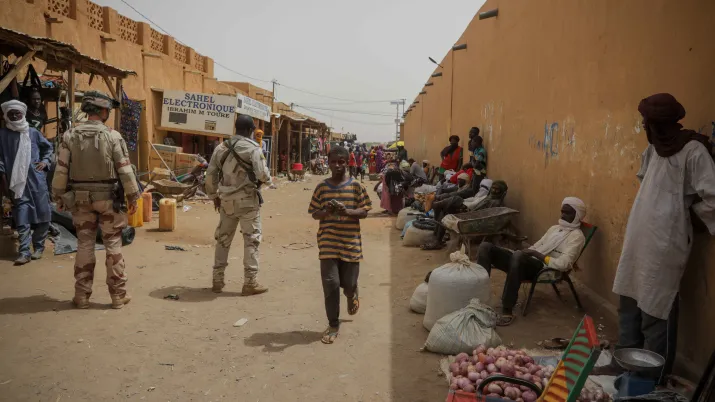
To combat the jihadist threat from the Sahel, the SHIELD project is supporting Benin, Togo, Ghana, and Côte d’Ivoire in the fight against improvised explosive devices and the proliferation of small arms and light weapons.
An approach focused on training and awareness-raising actions
To address the dual threat posed by the proliferation of improvised explosive devices (IEDs) and small arms and light weapons (SALW), the SHIELD project is building the long-term capacities of the defence and internal security forces of Benin, Togo, Ghana, and Côte d’Ivoire. It comes against the backdrop of armed terrorist groups extending their actions from the Sahel area to regions toward the south.
The project thus involves bringing together the various actors involved in the exposed areas: army, police, gendarmerie, water and forest authorities, customs officials, and special forces. It was designed to work at three complementary levels of action.
1. Training specialised personnel
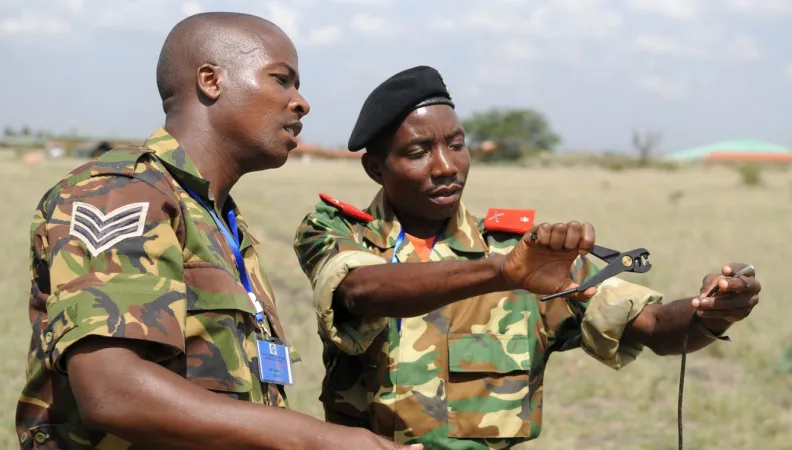
The project is training specialised personnel, including bomb-disposal experts and weapons stockpile managers, so that authorities in each country can then gain the capacity to train their own personnel in these skills.
2. Training first responders
Training is also offered to first responders to identify threats and secure sectors until specialists arrive. This training is based on a partnership with the French Security and Defence Cooperation Directorate (DCSD) and on so-called schools with a regional focus (ENVR) in the partner countries, including the Centre for Advanced Training in Post-Conflict Bomb-disposal and Remediation Actions (CPADD) and the Logistics Academy in Benin.
3. Tactical training
Tactical training is then organised in the countries concerned in order to put acquired skills into practice and to strengthen coordination between the various forces.
Awareness-raising actions for local people
At the same time, actions targeting people living in the most exposed areas are carried out to raise their awareness on the risks associated with explosive devices. These actions are accompanied by capacity-building for local authorities so that they can continue the awareness-raising over the long term.
Expertise from the NGO Mines Advisory Group (MAG) in particular helps support these activities.
Beyond equipment, building skills
The Gulf of Guinea countries have received significant amounts of equipment in recent years to fight the threat of IEDs. However, the training on this equipment has not always been sufficiently in-depth, as it has often focused on how to handle the equipment and less on the technical and tactical skills required for its use in the field.
This leads to a dual risk: underutilisation of the equipment due to a lack of sufficiently qualified personnel and continued dependence on external support. By focusing on the three complementary levels (training of specialists, training of first responders, and joint tactical training), the SHIELD project bridges the gap between available equipment and the skills needed to operate them.
The training of trainers also plays a key role, as it must enable the transmission of know-how over the long term and strengthen the autonomy of the partner countries, despite the high turnover of personnel in these specialised sectors.
Improving efficiency by boosting coordination between forces
The SHIELD project involves all defence and security forces (i.e., army, police, gendarmerie, water and forestry agents, customs officials, and special forces) rather than concentrating on only specialised military units. This choice responds to realities on the ground, as several institutions are mobilised to deal with the threat from IEDs and the circulation of SALWs, and operational efficiency largely depends on their capacity to coordinate themselves under a common chain of command.
This is the challenge of the project’s third priority action: the idea is not to provide training in silos for each intervention body, but to use joint training to develop common practices and reflexes that are crucial on the ground.
A dual advantage is provided by the involvement (through the partnership with the French Security and Defence Cooperation Directorate) of the partner-country schools with a regional focus: skills development is carried out within established and enduring systems already recognised by the States of the region, and active bilateral and regional cooperation is promoted.
Improved coordination of actions in the region
The project rounds out several initiatives already present in the region. Close coordination with these initiatives is therefore essential to avoid duplication and strengthen the complementarity of the actions.
On the civilian side, special attention will be paid to coordination with the European Union initiative in support of the Gulf of Guinea, in particular on security governance, prevention of violent extremism, and awareness-raising among people in border areas.
At the operational level, the project will also ensure complementarity with the operational military partnership detachments deployed by the French armed forces. Expertise France’s role is mainly in capacity-building and initial training, whereas the operational military partnership detachments provide more continuous support to units in the field.
In addition, regular exchanges with other partners active on IEDs and SALWs (European partners, United Nations agencies, and specialised NGOs) will make it possible to better coordinate actions and avoid overlap.
Sustainable Development Goals
SDG16 - Peace, justice and strong institutions
Promote just, peaceful and inclusive societies
On the same topic

EU Support to ECOWAS in Peace, Security and Governance (EPSG)
Ongoing
2024 - 2027
Funders : European Union, German State