Share the page
Financing the regenerative and sustainable blue economy In West Africa
Published on
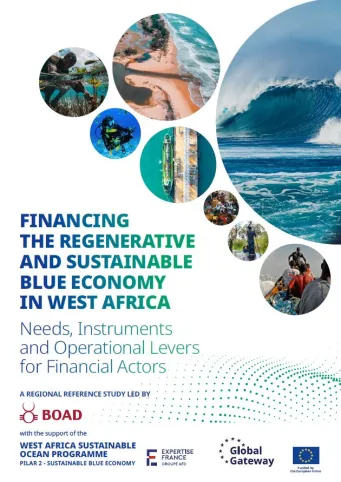
West Africa’s blue economy underpins jobs, food security, trade and regional integration. This study covers coastal, marine, estuarine, riverine and inland water systems from Mauritania to Nigeria. Along the wider coast, from Mauritania to Gabon, coastal areas host about one third of the population and generate about 56% of GDP.1
These assets, from ports and fisheries to coastal tourism and ecosystems, face growing pressure from erosion, flooding, pollution and climate change. The financing challenge is twofold: to support value creation while protecting the natural systems on which that value depends. The priority is to finance blue economy activity that is sustainable, regenerative, resilient, inclusive and measurable.
Financing the Blue Economy in West Africa: BOAD Publishes a Groundbreaking Regional Study
West Africa has considerable oceanic and coastal potential—from fisheries to ports, from coastal tourism to marine renewable energy, including mangroves and coastal ecosystems. However, financing for this blue economy remains fragmented, insufficient, and ill-suited to the realities faced by both project developers and financial institutions in the region.
To address this challenge, BOAD, in partnership with the European Union’s West Africa Sustainable Ocean Programme (WASOP), is publishing a regional study on blue finance in West Africa—the first comprehensive mapping of the needs, barriers, and available levers for action for sustainable finance stakeholders in the region.
A Study in Support of a Collective Goal
The study is part of the West African regional group of the FiCS Ocean Coalition, established in late 2025 and led by BOAD in partnership with BIDC, with support from the WASOP (West Africa Sustainable Ocean Programme)—Pillar 2 “Sustainable Blue Economy” implemented by Expertise France—funded by the European Union and an official partner of the Coalition. This study was conducted in partnership with the Ocean Risk Resilience Action Alliance (ORRAA), also a partner of the FiCS Ocean Coalition.
Structured around several strategic priorities—knowledge sharing and the development of common tools, the creation of financial instruments tailored to the blue economy, and the coordinated mobilization of public and private funding at the subregional level—the group has a clear goal: to mobilise USD 12 billion in investments to benefit coastal communities and the West African blue economy. To achieve this, three conditions are necessary: better-prepared projects, appropriate financial instruments, and strengthened coordination among stakeholders. The study specifically addresses these three challenges by creating a common foundation of regional knowledge upon which to build strategic partnerships and concrete actions for the region.
Unprecedented in its scope, it maps financing needs by sector and by type of stakeholder, identifies the structural barriers hindering capital flows to the blue economy, and formulates operational recommendations for financial institutions, donors, and project developers in the region.
A Structured Assessment, Operational Recommendations
Based on an analysis of priority sectors—fisheries and aquaculture, ports and maritime logistics, coastal tourism, coastal resilience, the circular economy, and marine ecosystems—the study identifies six categories of barriers that currently hinder the flow of financing: on the part of projects, banks, markets, financial instruments, data, and public policy.
In response, it proposes seven concrete operational levers: strengthening project preparation, creating dedicated “blue windows,” deploying guarantees and risk-sharing mechanisms, preparing blue bond issuances, mobilising blended finance and co-investment, gradually engaging commercial banks, and developing insurance and resilience instruments.
BOAD at the heart of the regional financial architecture
The study positions BOAD as the cornerstone of the regional blue finance architecture — directly linked to the 2026–2030 strategic plan Djoliba… the next step and its Climate Studies Fund, whose mandate explicitly covers blue finance operations. By combining concessional resources, guarantees, credit lines and project preparation, BOAD is able to act as a catalyst to mobilise public and private finance at sub-regional level.
You can watch the livestream of the COP31 side event presenting the study below.
Useful Information
-
Number of pages
-
80
-
Languages
-
English
Find out more about WASOP
WASOP - West Africa Sustainable Ocean Programme
WASOP supports the development of a sustainable and inclusive blue economy and the preservation of marine resources. It is addressing the challenges of overfishing, biodiversity conservation, climate...
- When ?
-
2024 - 2029
Status
Ongoing
- Location
- Africa
- Funders
- Union européenne
- Financing amount
- 28.5m on a total of 59m €