
Share the page

Mujeres echando raíces
Project
Published on
-
Project start date
-
Status
Ongoing
-
Project end date
-
-
Financing amount (Euro)
-
7m
-
Country and region
-
Colombia, Ecuador, The Americas
This project aims to help integrate Venezuelan migrant women into their host communities in Ecuador and Colombia by improving their living conditions.
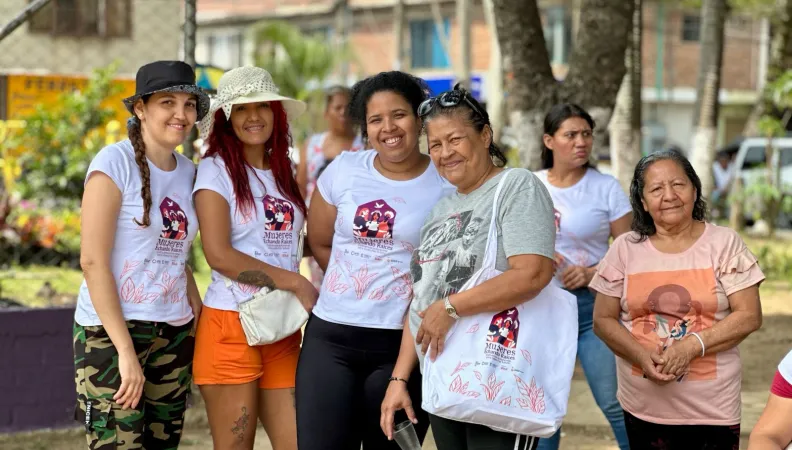
The Mujeres Echando Raíces project aims to integrate Venezuelan migrant women in Quito in Ecuador and Cali in Colombia by improving their living conditions. It focuses on four Sustainable Development Goals: end poverty, achieve gender equality, promote decent work and economic growth, and reduce inequalities.
This project follows on from Cruzando Fronteras, a project implemented by CARE from 2019 to 2021, in accordance with AFD’s development policies.
Mujeres Echando Raices project presentation
Increased gender inequalities in the Venezuelan migration context
The crisis in Venezuela has forced 6.81 million people to leave their country. There are currently 5.75 million refugees and migrants in Latin America, mainly in Colombia (2.48 million) and Ecuador (502,200). Only 12% of the financing needs for Venezuelans was covered in 2022, making this migration the most under-funded in the world. While public services and labour markets are saturated in the host cities, vulnerable people, especially women, have very few rights.
Migrant women, face even more difficulties in terms of socioeconomic integration due to the high levels of risk during their migration process, especially if they are undocumented.
While tackling gender equality is recognised as a priority for all the parties concerned, an operation to fight inequality between women and men in migration situations is necessary and expected by the Colombian and Ecuadorian authorities.
50% of migrant women
Women account for at least half of Venezuelan migrants.
In this context of migration, the Mujeres Echando Raíces project aims to strengthen the protection and socioeconomic integration of Venezuelan migrant women within the host communities in Cali in Colombia and Quito in Ecuador. It will also extend to Peru and Costa Rica, targeting the Nicaraguan migrant population in the latter country.
The project focuses on access to decent housing and the socio-professional integration of vulnerable migrant and local women. It is based on a “Housing First” approach, considering that housing is essential for the empowerment and inclusion of women. It also comprises training for institutional actors on migration and gender issues, with the aim of strengthening institutional capacities.
The project activities aim to achieve the following specific objectives:
- Support the implementation of a pilot project for a local public policy in Cali and Quito to provide Venezuelan migrant women and women in the host communities with access to decent housing, an income, and a life free of violence
- Conduct a feasibility study, with the aim of extending this approach to Peru (for Venezuelan women) and Costa Rica (for Nicaraguan women)
Explore the world of Mujeres Echando Raíces: Our Audiovisual Library
Activities divided into four main lines of action
The Mujeres Echando Raíces project is structured around four complementary components.
The first three components are implemented in Colombia and Ecuador by partner civil society organisations, which provide direct support to women beneficiaries. Expertise France is responsible for the overall coordination of the project, technical and operational monitoring, the monitoring, evaluation, accountability and learning (MEAL) framework, communication, and the mobilisation of technical assistance to strengthen the capacities of institutional partners: the Municipality of Cali (Colombia) and the Prefecture of Pichincha (Ecuador).
1. Improve access and conditions for rental accommodation
This component aims to facilitate access to decent, safe and sustainable rental housing for Venezuelan migrant women and women in vulnerable situations.
Partner organisations support beneficiaries throughout their housing journey: defining access arrangements, identifying available accommodation, raising landlords' awareness, providing financial assistance and, where necessary, carrying out housing improvement works.
At the same time, Expertise France mobilises technical expertise to document and build on this pilot experience and inform local authorities' efforts to develop more inclusive public policies on access to rental housing.
2. Support the economic integration of women
Partner organisations implement programmes designed to support women's economic empowerment. These include vocational training, assistance with labour market integration, and support for the creation or development of microenterprises, including through the provision of funding.
In addition, Expertise France supports the strengthening of local mechanisms through technical assistance, coordination platforms bringing partners together, and initiatives to document and share good practices.
These activities enable women beneficiaries to develop sustainable livelihoods and strengthen their economic independence.
3. Improve the women’s empowerment by preventing gender-based violence and providing access to sexual and reproductive healthcare
This component provides comprehensive social support aimed at promoting women's empowerment and their right to live free from violence.
Partner organisations deliver prevention, information and support activities for women affected by gender-based violence, as well as awareness-raising initiatives on sexual and reproductive health rights. They also train women leaders and community-based actors to strengthen local prevention and referral mechanisms.
The project also contributes to strengthening public services, notably through the provision of equipment to a sexual and reproductive health centre and health fairs in Quito, as well as to a support centre for women survivors of violence in Cali. Technical expertise is also mobilised to improve institutional support and referral mechanisms.
4. Conduct a feasibility study for the extension of the project to Peru and Costa Rica
Finally, the project includes a feasibility study to assess the conditions required for a potential expansion of the project's approach to other countries in the region.
The study draws on expert contributions, data collection and analysis, as well as lessons learned from project implementation in Colombia and Ecuador, with a view to developing a project proposal tailored to other national contexts.
More about this projet
Similar Projects
Regional Cooperation on Migration Policy (CRPM)
Ongoing
2024 - 2028
Funders : Agence Française de Développement

MEET Africa: European Mobilisation for Entrepreneurship in Africa
Ongoing
2025 - 2028
Funders : Agence Française de Développement

WATANI - Strengthening Tunisia’s entrepreneurial ecosystem
Ongoing
2025 - 2029
Funders : Agence Française de Développement
