Share the page
Ebola in DRC: “The laboratory plays a crucial role, confirming alerts and triggering response.”
Published on
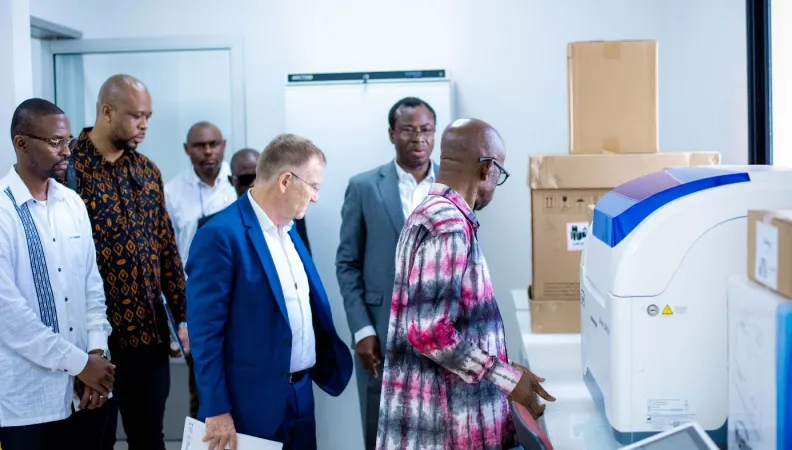
In Kinshasa, the Laboh-Kin project implemented by Expertise France with funding from Agence Française de Développement (AFD) contributes to capacity building in laboratories and improving epidemiological monitoring in a city-province and national transport hub of strategic importance.
Interview with Dr Arouna Traoré, Laboh-Kin project manager, and Dr Betty Mununga, head of epidemiological monitoring
As the Democratic Republic of Congo deals with a fresh Ebola outbreak, the topics of monitoring, diagnosis and preparation for health emergencies are once more under close scrutiny. In Kinshasa, the Laboh-Kin project implemented by Expertise France with funding from the French development agency (AFD) contributes to capacity building in laboratories and improving epidemiological monitoring in a city-province and national transport hub of strategic importance.
In this interview, Dr Arouna Traoré and Dr Betty Mununga discuss the current situation, the risks in Kinshasa, the role of laboratories and how projects reinforce the public health system.
How would you describe the current Ebola situation in DRC?
Dr Arouna Traoré:
It’s worrying. This epidemic was declared after the virus had already circulated in the community with a certain number of contacts across the population. It is no longer restricted to just one zone. Several provinces are affected, with population movements and contacts identified in various parts of the country, including Kinshasa.
Another important element is that the strain responsible for the outbreak is not the Zaire strain, for which vaccines are available. Making it more complicated to control the epidemic. During previous epidemics with the Zaire strain, we could rapidly deploy vaccines to protect those exposed, contacts and the emergency response team. This time, the situation is different.
So we need a swift, widespread response. If we don’t coordinate it properly, the situation could soon get out of hand.
Why has Kinshasa been subjected to specific monitoring?
Dr Betty Mununga:
Kinshasa is a national hub. People come here from all provinces, by air, river and road. Even if the epicentre of the epidemic is located elsewhere, Kinshasa may be exposed to the disease, leading to swift propagation.
During the 16th Ebola epidemic, the provincial Health Division had already drawn up a preparation plan. This plan is now being updated with the outbreak of this 17th epidemic. It must tighten up monitoring, especially at the various entry points to the city.
To date, three alerts have been sounded in Kinshasa, further to people coming from affected areas. Some alerts have been scaled back further to investigations and samples being taken. The first alert was cancelled after two samples proved negative, but the person was still monitored as a contact for 21 days, which is the incubation period for the Ebola virus. For another alert, we are waiting for the first sample results.
The immediate challenge is to tighten control measures at entry points: airport, ports and transit zones. We need lines of communication with the health zones in question, to share travellers’ health declarations, especially for those coming from the affected provinces and as part of screening schemes.
We also need to step up capacity-building for community liaison officers, who sound the alerts, and healthcare officers, who are especially exposed, working with patients on the front line.
Dr Arouna Traoré:
Kinshasa is especially at risk because of the sheer density of its population and cramped living quarters. Since the first Ebola epidemics in DRC, Kinshasa has never suffered a major epidemic. However, if the city were to be affected, the situation could very quickly spiral out of control.
Why are the laboratories so crucial during an Ebola outbreak?
Dr Arouna Traoré:
The laboratory plays an essential role, confirming whether or not there’s an epidemic.
The first symptoms of Ebola are very similar to those of malaria and other common infections. You might think it’s the flu or any classic fever or pathology. By the time the patient starts bleeding, the situation is already really critical.
So as soon as anyone suspects Ebola, samples need to be taken and sent to a reliable laboratory.
In an epidemic like Ebola, the laboratory shows what we are up against. Then we can isolate the patients, screen those in contact with them, protect the healthcare officers and trigger an appropriate response.
However, laboratories do not all have the necessary technical facilities, especially in molecular biology. Mobile laboratories and local schemes do help to screen for outbreaks more quickly, but you still need to have the right reagents and cartridges for the strain detected.
If a laboratory is not equipped to detect the strain in circulation, workers may hastily conclude that it is not Ebola, and they will fail to sound the alert.
What are the main challenges for the laboratory system today?
Dr Arouna Traoré:
The greatest challenge for laboratories is proximity. We can’t have laboratories everywhere, so we need to organise sample shipping.
Wherever a suspect case is identified, we need to take an on-site sample quickly and ship it within a reasonable time frame. This is a major challenge in terms of logistics.
In Kinshasa, for example, traffic jams, distances and hard-to-reach areas mean it can be difficult to get samples to the INRB or available laboratories. In other provinces, there are very remote places and others where security is compromised.
There are also operational restrictions: intrant availability, equipment, sample quality and the laboratory’s capacity to analyse the samples received.
The INRB plays a key role as the benchmark national laboratory. But up to now, many samples taken around Kinshasa have been sent straight to the INRB, without any intermediary structure involved that is capable of providing support. This increases the workload, leading to longer waiting times.
So the aim is to strengthen the network of laboratories capable of supporting the INRB and to bring some capacities closer to the field.
How is Laboh-Kin contributing to preparedness?
Dr Arouna Traoré:
Laboh-Kin especially contributes to capacity building for those involved in epidemiological monitoring in the city-province of Kinshasa. The project does not run nationwide, but its role is important in the zones where it is up and running.
There are 35 health zones in the city-province of Kinshasa. Laboh-Kin operates in six of these, on the outskirts, at entry points to the city. They are of strategic importance, since Kinshasa is connected to other provinces and Brazzaville.
Before you even reach the laboratory, Laboh-Kin has helped to secure the health information system and data feedback. The project has trained staff at all 35 health zones across Kinshasa on integrated disease surveillance and response, based on the WHO-recommended IDSR 3 approach. Prior to the project, health workers had not been trained in this strategic approach.
The project has also contributed to setting up rapid response teams in health zones. These teams can investigate alerts, assess how serious it is, report back to the central office and help with the initial response.
As for the laboratories, the first ones to be provided with support were hospital laboratories. They served the hospitals and were not designed to play a role in public health. With Laboh-Kin, we are building their capacity to also help with surveillance and the response to public health events, as backup for the INRB.
Dr Betty Mununga:
These laboratories are located at well-reputed general hospitals, yet did not always have the necessary facilities for this level. Thanks to Laboh-Kin support, they are now able to perform a wider range of tests.
This has strengthened the laboratory network and eased the INRB workload, which had taken on a lot of work nationwide. When all the samples had to be sent to the INRB, the time spent waiting for results also meant it took longer to identify and declare an epidemic then trigger the response.
Can we say that Laboh-Kin has strengthened preparedness for epidemics like Ebola?
Dr Arouna Traoré:
Yes, we can indeed say that Laboh-Kin has contributed, especially in the city-province of Kinshasa. The project has helped with monitoring capacity, the rapid response teams, data feedback and laboratory capacity to play a public health role.
Laboh-Kin has also helped to update the provincial contingency plan. Every year, the province has to gear up for various events: epidemics, catastrophes, flooding and other health emergencies. A new, updated contingency plan for 2026-2027, that factors in this fresh outbreak, is due for roll-out in early June.
This gives the province a framework in which to mobilise resources and organise the response to any major public health event occurring in Kinshasa.
With Expertise France, we should also mention Resoh-Labo, in South-Kivu, working to similarly reinforce laboratory and epidemiological monitoring systems. This province is in a zone that is highly vulnerable to epidemics. The project especially planned to build a provincial public health laboratory, but operations have been affected by the security situation.
In both cases, the aim is the same: to strengthen local monitoring capacity, laboratories and response.
Dr Betty Mununga:
Expertise France also worked on other epidemics, such as Mpox, cholera and measles, especially by way of response kits and test kits.
With Laboh-Kin, medicine has also been stockpiled at the central medicine purchasing body CAMESKIN. These stocks are available to the provincial health department in the event of an emergency, before other greater resources can be deployed by other partners.
On the same topic

In the news

Combating HIV/AIDS, tuberculosis, and malaria in the Greater Mekong Region
Published on December 16, 2024