Share the page
Reinforcing the role of civil society as the means to transformation
Published on
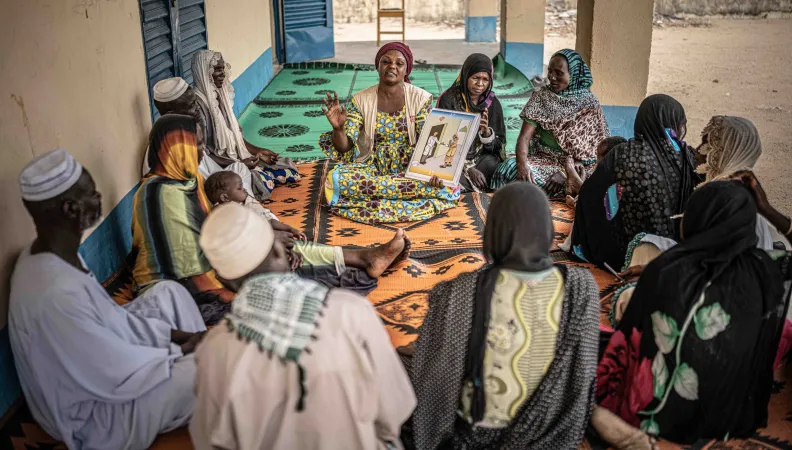
The agenda for renewal in Africa has set a clear-sighted goal: to harness cooperation as the means to tangible transformation for society, giving civil society a core role in initiatives for example. Against this backdrop, Expertise France supports civil society organisations using French and European funding.
The agenda for renewal in Africa aims to move beyond the classic remit for cooperation with African states and governments so that our international development initiatives are firmly rooted in society. Expertise France has helped to tailor our policy to new priorities, by way of 217 national and regional projects implemented in Africa from 2022 to 2025 with French and European funding, in contact and in close coordination with civil society, young people, diasporas and entrepreneurs.
Since 2022, we have worked with 304 civil society organisations (CSOs) to implement projects in Africa worth 123 million euros. This amount has quadrupled in three years.
Civil society driving social and health transformation with “L’Initiative”
Civil society organisations perform a key role in pushing back against AIDS, tuberculosis and malaria, yet all too often they are left out of decision-making. They have trouble weighing in on policy that directly affects the people they support due to a lack of reliable funding and sufficient structure. L’Initiative is stepping up its support in order to consolidate these organisations and empower them to play a fuller role in health governance, despite the general trend towards cuts in international funding.
SOFIA is a mechanism that supports 20 civil society organisations in eight countries in West and Central Africa. Launched in 2023, SOFIA combines financial and technical support to strengthen their in-house organisation, independence and the role they play in healthcare systems. This support helps to clarify their positioning and better advocate for their priorities when approaching authorities and partners.
Great progress has been made in Djibouti for example, where until now civil society has mostly been very loosely organised, with little opportunity to help shape public policy. SOFIA has helped the organisations Autre Regard and Solidarité Féminine gain a seat on the Country Coordinating Mechanism (CCM), where they help shape strategy, especially regarding community screening. Their role is no longer restricted to implementation: they now take part in decision-making and put forward proposals.
- Find out more: Civil society, a driver of social and health transformation
Supporting the production of economic knowledge in Tunisia
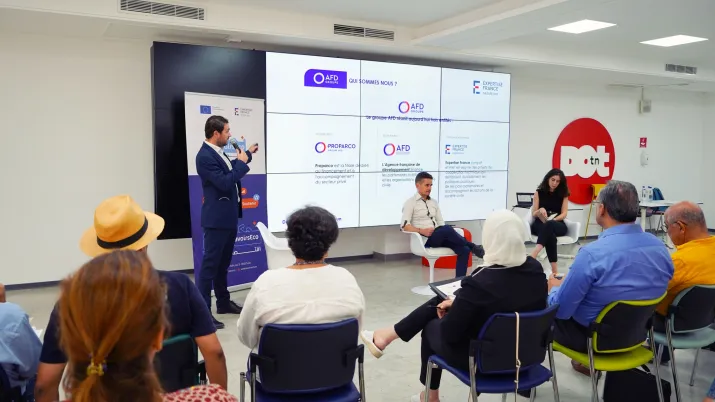
The EU-funded project Savoirs Eco (Economic Knowledge) deploys an embedded mechanism in Tunisia to shape support for think tanks from civil society, based on an operational combination of competitive funding, capacity building and support for action-research. The project has leveraged several well-targeted calls for projects, thus empowering organisations, NGOs and economic research institutes to organise their research work, scale up the professionalism of their analysis and strengthen their positioning in public debate and the shaping of economic policy.
The adopted approach favours action-research as a core lever in the production of knowledge. The organisations are provided with support to design and implement research focussing on local socio-economic realities, and top-priority themes such as social and solidarity-based economies (ESS), environmental transition, social justice, gender equality, territorial dynamics and economic cohesion. This research work combines the collation and processing of empirical data, in-depth economic analysis and the drafting of implementable recommendations for decision-makers, local authorities and stakeholders in the field.
Supporting open French-speaking governments with PAGOF
While acting as co-president of the Open Government Partnership (OGP) in 2016-2017, France pledged to support transparency in public action at international level with a show of support for French-speaking countries implementing their plan of action. Having partnered CFI to support three countries from 2017 to 2022, Expertise France continued to support four more OGP member countries in French-speaking Africa: Côte d’Ivoire, Morocco, Senegal and Tunisia, still with AFD funding.
PAGOF contributes to a host of tangible reforms, in collaboration with 45 central administrations, 667 active stakeholders from civil society, and three public service training schools. This has produced a ripple effect beyond the national scope of reform, branching out to encompass local governments, parliaments, independent institutions and national public service training schools. The project has also empowered African initiatives suggested by the stakeholders themselves.
Lastly, PAGOF has maintained ties between agents of reform, supported civil society and preserved institutional achievements, especially in Tunisia and Senegal, despite instability, the shrinking of civil society and ongoing change.
Supporting CSO promotion of gender equality with the EDIFIS gender fund
Since 2021, the EDIFIS gender fund has been deployed in West Africa and the Gulf of Guinea. Currently in its second phase, it helps CSOs scale up their action and impact in favour of gender equality. In a region suffering from serious gender inequality, demographic challenges and a high prevalence of gender-based violence, this programme supports innovative local initiatives while consolidating stakeholders’ organisational, financial and technical capacity.
During the initial phase which lasted until 2025, funds were granted to 18 initiatives involving 21 CSOs in several countries. They achieved many tangible results: informing women of their rights, instilling confidence, improving response to victims of violence, and spurring development in social norms, especially via the promotion of positive masculinity.
In Mauritania for example, CSVVDH and ATED developed an innovative application called Sentinelle, to flag gender-based violence (GBV) quickly and anonymously. The application ensures swift intervention, as well as generating much-needed statistics regarding the most common forms of violence, thus further empowering prevention and support for victims.
Developing leadership among young people in Sub-Saharan Africa with Team Europe
Young people in Africa today have an opportunity to take up many of the continent’s challenges, from employment to political instability.
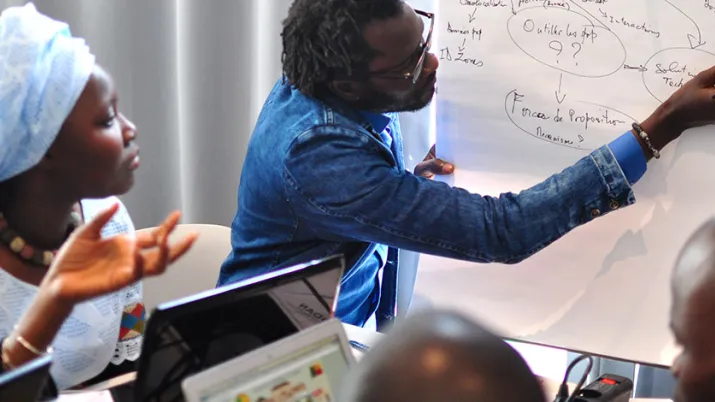
The Africa-Europe Youth Academy (AEYA) is one of the EU’s flagship initiatives, within the Youth Action Plan (YAP) and part of the Global Gateway Africa-Europe. Designed as a practical response to young people’s aspirations and the challenges they face, AEYA aims to instil a sense of leadership among young people in Sub-Saharan Africa while forging lasting ties with their European peers.
Implemented with the Italian cooperation agency, this 4-year programme plans to support 50 organisations in the development of arenas for young people. Young people will enjoy support via the AFD Campus Group. Training programmes will also be developed, catering to over 1,000 young leaders, including 50% women and 25% disabled people.
Discover our projects
Savoirs éco: support for economic knowledge players Tunisia
Ongoing
2023 - 2026
Funders : European Union
Project Africa-Europe Youth Academy (AEYA) - Develop youth leadership in Sub-Saharan Africa
Ongoing
2025 - 2029
Funders : European Union